Best cookware sets
Quick answer
The Cuisinart 12-Piece Stainless Steel Set ($219.95) is the best all-around cookware set for most kitchens: it is induction compatible, built with tri-ply clad construction so heat spreads up the walls instead of just the base, and it covers pots, pans and lids in one purchase.

Cuisinart Stainless Steel Pots and Pans Set, Induction Compatible, 12 pc
12 piecesThis 12-piece Cuisinart set uses tri-ply clad construction, meaning the aluminum core runs all the way up the sidewalls, not just the base, so sauces do not scorch at the edges. It is induction compatible out of the box, which many sets under $250 are not, and 12 pieces covers a full rotation of pots, pans and lids without paying for filler items you will not use.
The three tiers
Beginner: Best first set
someone buying their first set and unsure what they will use- Beginner pick
CAROTE 21pcs Pots and Pans Set Non Stick, Detachable Handle Cookware, Black
21 pieces$59.99 Check pricePrices change often

The CAROTE 21-Piece Nonstick Set costs $59.99 and gives a new cook every common pan size plus lids, utensils and detachable handles that let the pans nest flat in a cabinet. Nonstick is forgiving while someone is still learning heat control: eggs, pancakes and fish release without sticking, and there is no seasoning routine to maintain. Twenty-one pieces sounds like a lot, but several are lids and tools, so the actual cookware count is closer to eight or nine pans and pots, which is a realistic number for a first kitchen.
Not for: Someone who wants to sear steaks hard or deglaze a pan for a pan sauce. Published PTFE nonstick coatings top out around 400F to 500F and start breaking down near the top of that range, so this set is not built for high-heat searing or for scraping up fond.
Intermediate: Best value
a cook who has outgrown nonstick and wants real stainless steel performance without paying flagship prices- Intermediate pick
Cuisinart Stainless Steel Pots and Pans Set, Induction Compatible, 12 pc
12 pieces$219.95 Check pricePrices change often
The Cuisinart 12-Piece Stainless Steel Set at $219.95 is tri-ply clad, so the aluminum core is bonded between stainless layers up the full height of the pan, not just under the base. That means a sauce or a browned fond will heat evenly across the whole pan, not just scorch in the center. It is induction compatible, dishwasher safe, and the 12-piece count maps closely to what a household of two to four actually cooks with day to day: a saute pan, a stockpot, saucepans and a skillet.
Not for: Someone who wants designer handles, a lifetime warranty backed by a US factory, or the extra polish of a flagship brand. It is also not the right pick for someone who mostly fries eggs and wants the ease of nonstick.
Expert: Performance ceiling
a cook who sears regularly, makes pan sauces, and wants a set that will outlast the kitchen it is bought for- Expert pick
All-Clad D3 Stainless Steel Cookware Set, 10-Piece, Made in the USA
10 pieces$799.95 Check pricePrices change often
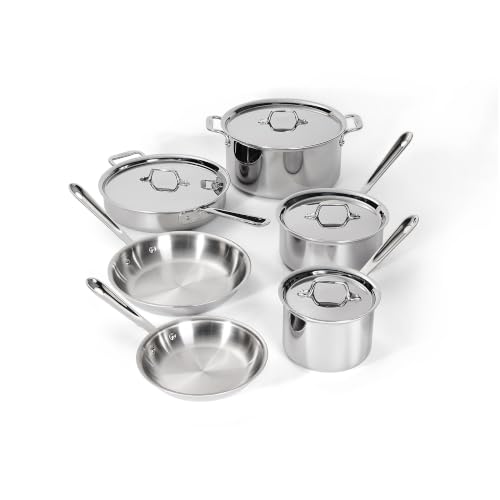
The All-Clad D3 Stainless Steel 10-Piece Set at $799.95 is the complete version of this argument: six vessels and four lids, all made in the USA, all fully tri-ply clad, and all published by All-Clad as oven and broiler safe to 600F, roughly 100F above most mid-tier stainless sets. Aluminum conducts heat at about 237 W/m-K against roughly 16 W/m-K for stainless alone, a fifteen-fold difference, and D3 runs that aluminum core up the entire pan wall rather than stopping at a disc on the base, which is what lets a sauce reduce evenly instead of scorching at the waterline. The ten-piece covers 8 and 10 inch fry pans, 2 and 3 quart saucepans, a 3 quart saute pan and an 8 quart stockpot, so nothing else is needed.
Not for: A cook who cooks two or three nights a week or mostly boils pasta and steams vegetables. At that frequency, the $219.95 Cuisinart tri-ply set above will behave almost identically on the stove, and the roughly $580 difference is far better spent on a cast iron skillet, a carbon steel pan and a genuinely good chef knife, all of which change daily cooking more than a flagship set will. The 5-piece D3 set at $399.99 is also the more sensible entry point if the pieces you actually reach for are a skillet and one saucepan.
| Product | Price | Construction | Oven safe |
|---|---|---|---|
| CAROTE 21-Piece Nonstick Set | $59.99 | Aluminum body, nonstick coating | 400F to 500F (coating dependent) |
| Cuisinart 12-Piece Stainless Steel Set | $219.95 | Tri-ply clad | 500F (Chef's Classic line rating) |
| LEGEND COOKWARE 14-Piece Set | $549.99 | 5-ply clad | Manufacturer published, check listing |
| All-Clad D3 5-Piece Set | $399.99 | Tri-ply clad, made in USA | 600F |
What is the real difference between a starter set and a full set?
A starter set is built around one or two pan sizes that cover the most common tasks: an 8 to 10 inch fry pan for eggs and searing, and a 3 to 4 quart saucepan or saute pan for sauces and reheating. A full set adds a stockpot for pasta and stock, a smaller saucepan for melting butter or making a roux, and often a steamer insert or a second fry pan size.
The jump in price from a starter set to a full set is rarely about better materials. It is almost always about more pieces of the same construction. A shopper trying to decide between an 8-piece and a 17-piece set from the same brand and material line should check whether the extra pieces are pans they will use weekly or lids and utensils they already own.
Should a beginner buy nonstick or stainless steel first?
Nonstick is the better first purchase for someone who has not yet learned to control heat and preheat time, because it forgives sticking mistakes that would ruin food in a bare stainless pan. Eggs, pancakes, fish and delicate proteins release cleanly even at lower skill levels.
Stainless steel becomes worth the learning curve once a cook wants to sear meat, build fond for a pan sauce, or use a pan under a broiler or in a hot oven, tasks where nonstick coatings are not rated to perform. Most experienced home cooks end up owning both: nonstick for eggs and delicate fish, stainless or clad for everything that benefits from a hard sear.
Why do cookware sets range from $60 to $800 for a similar piece count?
The spread comes from three variables: how much aluminum or copper core is bonded into the pan, how far up the wall that core extends, and where it is manufactured. A $59.99 nonstick set uses a single layer of stamped aluminum with a sprayed coating. A $219.95 tri-ply set bonds three layers, aluminum between two stainless sheets, through rolling and bonding processes that cost more per pan. A $399.99 to $784.77 set from All-Clad or Made In uses the same tri-ply or 5-ply principle but is manufactured domestically with tighter tolerances and heavier gauge metal, which raises both material and labor cost.
None of this means the expensive set cooks food that tastes different. It means the expensive set holds even heat more forgivingly and survives more years of daily use, which matters more to someone who cooks nightly than to someone who cooks twice a week.
What pieces from a set do most home cooks actually use?
Owner reports and manufacturer usage data consistently point to the same handful of pieces: a 10 to 12 inch fry or saute pan, an 8 quart or 6 quart stockpot, and one or two saucepans in the 2 to 4 quart range. Steamer inserts, small egg pans and the smallest saucepan in a set are the pieces most often reported as unused after the first year.
- Most used: large fry pan, stockpot, mid-size saucepan
- Least used: steamer insert, smallest saucepan, specialty egg pan
Do you need a lid for every pan in the set?
No, and this is one of the easiest ways to cut cost without losing function. A universal lid that fits multiple pan diameters covers most simmering and reheating needs, and a fry pan used mainly for searing rarely needs a lid at all. Sets that advertise a lid for every single piece are often padding the piece count rather than adding cooking capability.
When comparing two sets at a similar price, check whether the lids are glass or metal. Glass lids let you check food without releasing heat, which is useful for simmering sauces or steaming vegetables, while metal lids are generally more durable and less prone to cracking from a sudden temperature change, such as being set down on a cold countertop straight from a hot oven.
How much does copper cookware add over stainless clad construction?
Copper conducts heat even faster than aluminum, which makes it the preferred material for professional pastry work and delicate sauces that need split-second temperature adjustments. It is not included in most home cookware sets because it requires more careful maintenance, tarnishes visibly, and is significantly more expensive per pan than an aluminum core, which is why nearly every set in this comparison, from the CAROTE 21-Piece Nonstick Set to the All-Clad D3 5-Piece Set, relies on an aluminum core rather than copper.
For a home cook deciding between a tri-ply aluminum-core set and a rare copper-core set at a similar price, the aluminum-core set is almost always the more practical choice, since it delivers most of the responsive heating benefit at a fraction of the maintenance burden.
How we chose
Every recommendation on this page is researched from published manufacturer specifications, such as oven-safe temperature ratings, piece counts, base construction and material composition, cross-checked against owner reports and manufacturer documentation. Nothing here is based on in-person cooking or lab testing of the pans themselves.
We prioritized construction over piece count, because a 21-piece set with a thin base is not a better buy than an 8-piece set that is clad all the way up the wall. We also weighted oven-safe rating and induction compatibility heavily, since those two specs eliminate a set from consideration for a lot of kitchens regardless of price.
Buying tips
How many pieces do you actually need?
Piece counts are inflated by lids, utensils and storage racks, so a 21-piece set is usually 8 to 10 actual cooking vessels. Before buying a large set, count what you already own and only replace it. Most two to four person households use one large skillet, one saucepan, one stockpot and one sauté pan on a weekly basis, and everything past that sits in a cabinet.
Tri-ply clad or disc base, does it matter for a full set?
It matters more in a set than in a single pan. A disc-base pot has aluminum only in a puck welded to the bottom, so the sidewalls are plain stainless and conduct heat poorly. That is fine for boiling water but it means a tall stockpot or a deep sauté pan will show a hot ring at the base and cool walls above it, which scorches sauces that climb the sides. Tri-ply clad construction runs the aluminum core up the full wall, so heat is even from the base to the rim.
What oven temperature do you actually need?
Check this before you buy, not after a recipe calls for a 450F finish under the broiler. All-Clad publishes 600F oven safe for its D3 and D5 lines. Cuisinart publishes 500F for its Chef's Classic stainless line. Nonstick sets are the outlier: PTFE coatings are published at 400F to 500F and begin breaking down near the top of that range, so a nonstick set is a poor match for a recipe that finishes in a hot oven.
Is induction compatibility worth checking before you buy?
Yes, and it costs nothing to check. Induction cooktops only heat cookware with a magnetic base, so all-aluminum or all-copper cookware without a steel layer will not work at all. Most modern stainless and clad sets list induction compatibility directly in the title or spec sheet. If there is any chance your next range is induction, buying a compatible set now avoids replacing everything later.
Should you buy a matching set or build one piece at a time?
A matching set guarantees consistent construction, stackable storage and lids that fit across pieces, which is convenient for a first kitchen where nothing else is already owned. Building piece by piece lets you put more budget into the pans you use most, such as a heavier All-Clad D3 skillet for searing, while filling in a stockpot or saucepan with a cheaper disc-base option, since a stockpot spends most of its time simply boiling water and does not benefit as much from tri-ply construction.
Other options worth knowing about
- CAROTE
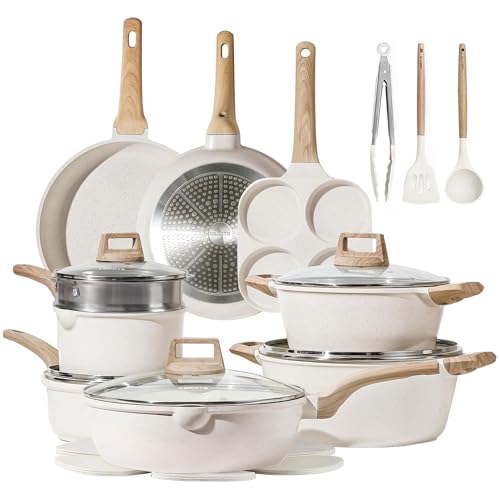
CAROTE 21pcs Pots and Pans Set, Nonstick Cookware Sets, with Egg Pan
21 pieces$189.99 Check pricePrices change often - Tramontina
Tramontina Signature Tri-Ply Clad Stainless Steel 10-Pc Pots and Pans Set
10 pieces$329.99 Check pricePrices change often - All-Clad
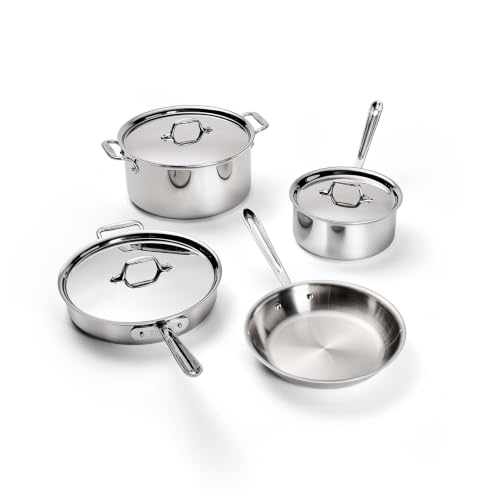
All-Clad D3 Stainless Steel Cookware Set, 7-Piece, Made in the USA
7 pieces$599.99 Check pricePrices change often - All-Clad
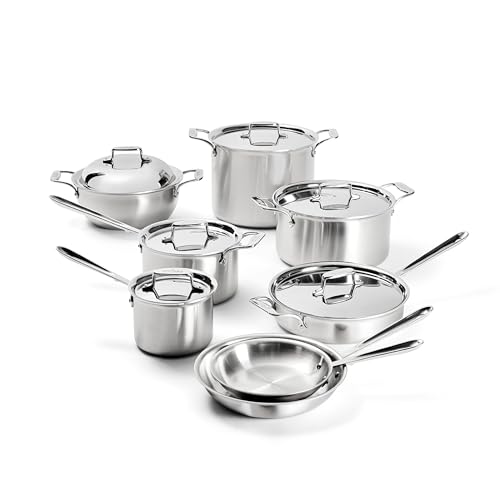
All-Clad D5 Stainless Steel 14-Piece Cooking Set, Made in the USA
14 pieces$1,499.95 Check pricePrices change often


Common questions
What is the best cookware set for someone who has never owned real cookware?
A nonstick set in the $60 to $120 range, such as the CAROTE 21-Piece Nonstick Set at $59.99, is the most forgiving starting point. It handles eggs, pancakes and everyday sauteing without requiring precise heat control, and it costs little enough that upgrading to stainless later does not feel wasteful.
Is a 5-ply cookware set worth the price over tri-ply?
For most home cooks, no. Tri-ply already puts an aluminum core through the full pan wall, which solves the uneven heating problem. Five-ply adds extra layers mainly for stiffness and a heavier feel rather than a meaningful jump in heat distribution, so the extra cost is better justified by durability and warranty than by cooking performance.
Can I mix and match instead of buying a set?
Yes, and many experienced cooks do exactly that: a cast iron or carbon steel skillet for searing, a stainless saucepan for sauces, and a nonstick pan for eggs. A set is convenient for matching lids and stackable storage, but nothing about cookware requires buying it as a bundle.
Does a higher price always mean better heat distribution?
Not automatically. Heat distribution depends on whether the conductive core runs up the pan wall or sits only in the base, not on price alone. A $219.95 tri-ply set can distribute heat more evenly than a disc-base set that costs more simply because it carries a premium brand name.
Are induction-compatible sets more expensive?
Not necessarily. Induction compatibility only requires a magnetic stainless steel base, which most modern stainless and clad cookware already has. Budget sets under $100 and flagship sets over $500 both commonly list induction compatibility, so it is worth checking the spec rather than assuming price determines it.
What oven-safe rating do I need for everyday cooking?
Most home recipes that finish a dish in the oven call for 400F to 450F, which nonstick, stainless disc-base and tri-ply clad sets can all handle. A 600F rating, like the one All-Clad publishes for D3, only matters for high-heat searing techniques that finish under a broiler or in a very hot oven.