Cookware set builder
Quick answer
Most households of three or four who cook from scratch need about eleven pieces, not the twenty a boxed set advertises. A 10 inch skillet, a 12 inch skillet, a nonstick pan, two saucepans, a saute pan, a dutch oven, a stockpot, two sheet pans and a chef knife covers almost everything. The advertised piece count on a set includes the lids.
Which pieces earn their cupboard space is a judgement, not a specification. The prices are real and come from live listings; the selection rules are stated openly so you can disagree with them.
What to skip, and this is the part worth reading twice:
The lids counted as pieces: In a typical eleven-piece set, five of the eleven are lids. Count vessels, not pieces, when you compare two sets.
The 1 quart saucepan: A 2 quart pan does everything it does and more. It is the piece most likely to sit unused in the back of a cupboard.
The steamer insert: A collapsible steamer basket costs a few dollars and fits several pots. As a set component it inflates the piece count and fits exactly one.
Included plastic utensils: They are counted as pieces, they are usually the worst utensils in the kitchen, and they exist to make the number on the box larger.
The 8 inch skillet, if you have a 10 inch: The 10 inch does the 8 inch's job with room to spare. Two small skillets is a common way to end up with no large one.
The single most useful thing to know about cookware sets: the advertised number counts lids. All-Clad's own 10-piece D3 set is six pans and four lids, and that is an honest ratio. Above about twelve advertised pieces, the extra numbers are rarely pans.

Cookware sets, cheapest first
Prices come from live listings and move constantly. Use these to see the shape of the category, then check the current figure.
- Tramontina
Tramontina Signature Tri-Ply Clad Stainless Steel 10-Pc Pots and Pans Set
10 pieces$329.99 Check pricePrices change often - All-Clad
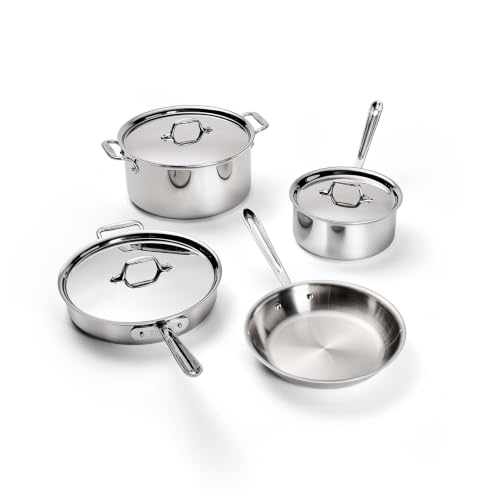
All-Clad D3 Stainless Steel Cookware Set, 7-Piece, Made in the USA
7 pieces$599.99 Check pricePrices change often - All-Clad
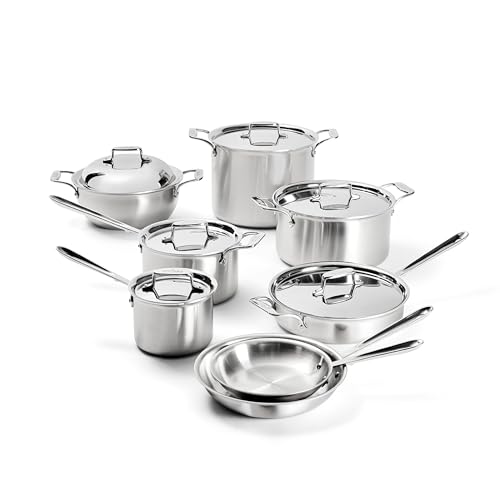
All-Clad D5 Stainless Steel 14-Piece Cooking Set, Made in the USA
14 pieces$1,499.95 Check pricePrices change often


Common questions
Why does this recommend fewer pieces than a cookware set contains?
Because a set is priced and marketed on its piece count, so it is built to make that number large. Lids count as pieces, and so do steamer inserts and plastic utensils. A set advertised at twenty pieces routinely contains seven or eight actual pans. Counting only the vessels you will genuinely use gives a smaller, more expensive-looking list that costs less in practice.
Is it cheaper to buy a set or individual pieces?
A set is usually cheaper per pan, and that only helps if you would have bought those pans anyway. The common failure is paying for a 1 quart saucepan, an 8 inch skillet and a steamer insert that never leave the cupboard. Sets make sense when the vessel list matches what you cook; open stock makes sense when it does not.
Should every pan be the same material?
No, and matching sets are the reason people think it should be. No single material is good at all four common jobs. Clad stainless sears and makes pan sauces, cast iron or carbon steel holds heat for a crust, nonstick handles eggs and fish, and enamelled cast iron takes long acidic braises. A mixed kitchen outperforms a matched one at every budget.
What is the one piece most people are missing?
A saute pan, meaning straight sides and a lid rather than the flared walls of a skillet. It browns and then braises in the same vessel, which is what most weeknight cooking actually is. It is the piece most often left out of smaller sets and the one people notice immediately once they have it.
How accurate is the running total?
The prices come from live retailer listings at build time and they move constantly, which is why every product card carries that warning. Treat the total as the shape of the budget rather than a quote. The ordering matters more than the exact figure: it shows you where the money actually goes, which is almost always the pans rather than the accessories.