Cookware materials compared
Quick answer
Copper conducts at about 401 W/m-K, aluminium 237, cast iron 52, carbon steel 50 and stainless just 16. Conductivity is not the same as heat retention: cast iron conducts poorly and holds a great deal of heat, which is exactly why it sears well. No single material is good at every job, so a mixed kitchen outperforms a matching set at every budget.
Conductivity and density are published material properties. Oven ceilings are what manufacturers publish for each class of cookware and vary by brand.
| Material | Conductivity | Heat retention | Response | Induction | Oven ceiling | Reactive |
|---|---|---|---|---|---|---|
| Tri-ply stainless clad | 237 W/m-K | medium | high | Yes | 600F | No |
| Five-ply stainless clad | 237 W/m-K | medium to high | medium, because the extra mass takes longer to change temperature | Yes | 600F | No |
| Disc-base stainless | 237 W/m-K | medium on the base, low on the walls | high | Yes | 500F | No |
| Bare cast iron | 52 W/m-K | very high, because of mass rather than conductivity | low, it takes several minutes to preheat and just as long to cool | Yes | 700F | Yes |
| Carbon steel | 50 W/m-K | medium, well below cast iron because it is much thinner | high, which is the whole reason a professional kitchen uses it | Yes | 600F | Yes |
| Enamelled cast iron | 52 W/m-K | very high | low | Yes | 500F | No |
| PTFE nonstick | 237 W/m-K | low | very high | Depends on the base | 400F | No |
| Ceramic nonstick | 237 W/m-K | low | very high | Depends on the base | 350F | No |
| Bare or anodised aluminium | 237 W/m-K | low | very high | No | 500F | Yes |
| Plain stainless steel | 16 W/m-K | low | medium | Depends on the base | 500F | No |
| Copper, lined | 401 W/m-K | medium | the highest of any cookware material | No | 450F | No |
| Stoneware and ceramic bakeware | 1.5 W/m-K | high | very low | No | 450F | No |
| Tempered glass bakeware | 1 W/m-K | medium | low | No | 425F | No |
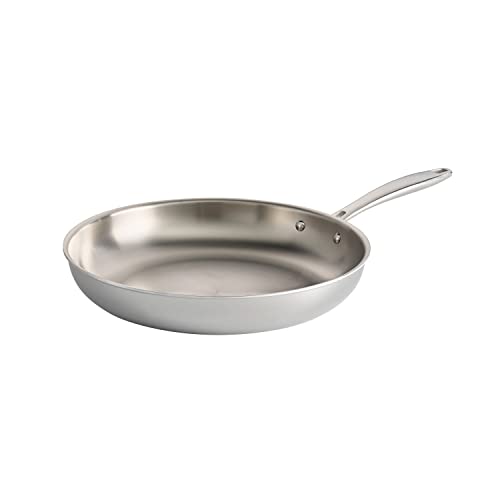
Tramontina Signature Tri-Ply Clad Stainless Steel 12-Inch Large Frying Pan
12 inFully clad means the aluminium core runs up the walls as well as across the base, so a reduction does not scorch at the waterline. It is the pan for anything that ends in a fond and a deglaze.
Conductivity and heat retention are not the same thing
This is the misunderstanding that drives most bad cookware buying. Conductivity measures how fast heat travels through a material. Heat retention measures how much energy the material holds once it is hot, which comes from mass and specific heat rather than conductivity.
Cast iron is the clearest example. It conducts at about 52 W/m-K, which is poor, roughly a fifth of aluminium. It is also thick and dense, with a density of about 7.2 g/cm3, so a hot iron pan is holding a large amount of energy. When a cold steak lands on it, the surface temperature barely drops. That is what produces a crust, and it is why iron sears better than a thin aluminium pan that conducts four times as well.
The reverse is true for sauces. Copper, at about 401 W/m-K, responds the instant the burner changes, which is what sugar work and delicate emulsions need. It has no particular advantage in searing.
Why a matching set is rarely the right purchase
A set forces one construction on every job. The four jobs a kitchen actually asks of its pans are searing and building fond, releasing delicate food, holding steady heat through a long acidic braise, and boiling water. Those want clad stainless, nonstick, enamelled iron and a cheap disc-base pot respectively, and no single material does two of them well, let alone all four.
The practical consequence: a small honest set plus one cast iron pan and one nonstick pan produces a better kitchen than a large matching set at the same price. The only thing lost is that the cupboard looks less coordinated.
The oven ceiling is almost never the metal
A pan is only as oven safe as its lowest rated part, and that is the handle far more often than the material. Stainless and cast iron are unbothered by any normal oven temperature, while a silicone sleeve softens around 400F and a phenolic handle chars around 350F. If the pan goes in covered, a glass lid at 350F to 425F or a phenolic knob at about 375F can be lower still.
The oven ceiling calculator works out the real limit for any combination and tells you which part set it.
One of each: the mixed kitchen
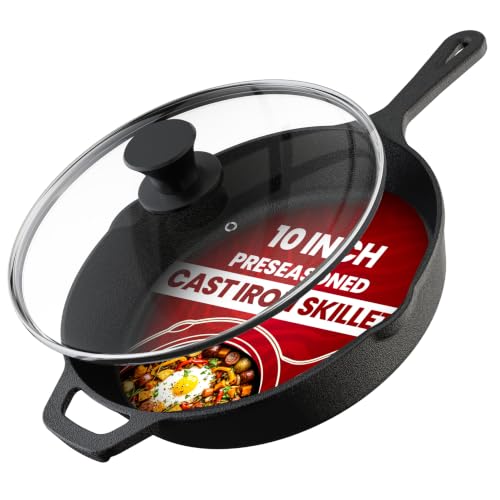
- Utopia Kitchen
Utopia Kitchen Cast Iron Skillet 10 Inch with Lid Chefs Frying Pan Black
10 in$25.99 Check pricePrices change often - JANSKA
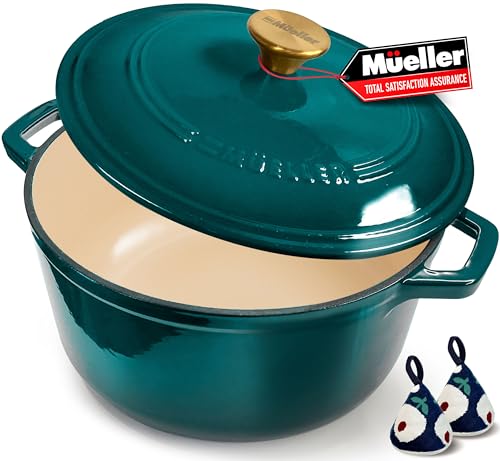
Mueller DuraCast 6 Quart Enameled Cast Iron Dutch Oven Pot with Lid
6 qt$52.97 Check pricePrices change often - Lodge
Lodge Essential Enamel Cast Iron Dutch Oven, 6 Quart, Oyster White
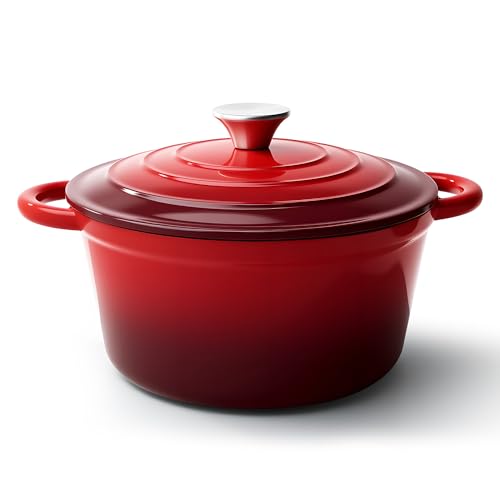
6 qt$89.90 Check pricePrices change often - Le Creuset
Le Creuset Enameled Cast Iron Round Dutch Oven, 7.25 qt., Cerise
7.25 qt$325.99 Check pricePrices change often



Common questions
Which cookware material conducts heat best?
Copper, at about 401 W/m-K, followed by aluminium at about 237. Stainless steel is poor at about 16, which is why almost every good stainless pan bonds aluminium inside it. Cast iron sits at about 52 and carbon steel about 50. High conductivity means the pan reaches an even temperature quickly and responds fast when the heat changes.
What is the difference between conductivity and heat retention?
Conductivity is how fast heat moves through the material. Heat retention is how much energy the material holds once hot, which comes from mass and specific heat. Cast iron conducts poorly and retains enormously well, so a preheated iron pan barely cools when cold food lands on it. That is what produces a crust, and it is why iron sears better than aluminium despite conducting far worse.
Which materials work on induction?
Cast iron, carbon steel, enamelled cast iron, and any clad or disc-base pan with a magnetic exterior. Aluminium, copper, glass and stoneware do not. Coated aluminium pans work only if a magnetic plate was bonded to the base. Austenitic 18/10 stainless, grade 304, is not magnetic; ferritic 430 is, which is why clad pans use it on the outside.
Why should not all my pans match?
Because no single material is good at all four common jobs. Clad stainless sears and builds fond for a pan sauce. Cast iron or carbon steel holds heat for a hard crust. Nonstick releases eggs and delicate fish and cannot be run hot. Enamel is inert and takes long acidic braises. Buying one of each outperforms buying four of any one of them.
Which materials are reactive with acid?
Bare cast iron and carbon steel, where long acidic simmering strips the seasoning layer and can leave a metallic taste, and bare aluminium, which discolours both itself and the food. Stainless, enamel, glass and stoneware are all inert. That is why a two hour tomato braise belongs in enamelled cast iron rather than a bare iron pan.