Fully Clad vs Disc-Base Stainless
Quick answer
Buy the Tramontina Signature Tri-Ply Clad 8-Piece Set ($237.46) for sauce pans and skillets where the walls need to stay warm; the Cuisinart 77-10P1 Disc-Base 10-Piece Set ($169.21) is a smart budget pick specifically for a stockpot, where only the base ever touches direct heat.

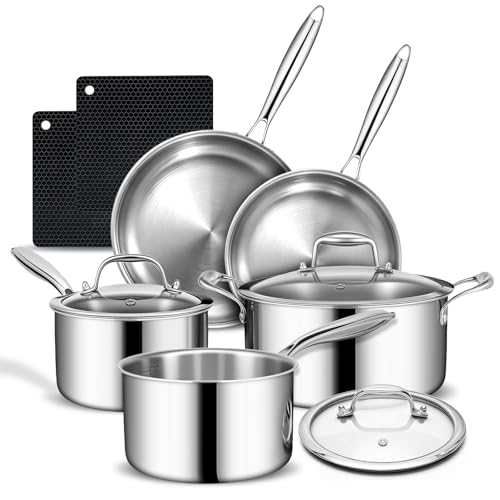
Tramontina Signature Tri-Ply Clad Stainless Steel 8-Pc Pots and Pans Set
8 piecesSaucepans, skillets, and saute pans where sauces or food touch the sidewalls and need even heat all the way up, not just at the base.
| Fully Clad | Disc-Base | |
|---|---|---|
| Aluminum core location | Base and up the sidewalls | Base only |
| Sidewall heat | Even, warm to the touch when cooking | Cooler, walls stay closer to ambient |
| Scorching risk at the waterline | Low | Higher in sauces and reductions |
| Best pieces for this construction | Skillets, saucepans, saute pans | Stockpots, pasta pots |
| Relative price | Higher per piece | Lower per piece |
| Price, comparable set | $237.46 | $169.21 |
What fully clad actually means
Fully clad cookware bonds an aluminum or copper core between layers of stainless steel across the entire pan, base and sidewalls both. That means heat conducts evenly not just where the pan touches the burner, but up the sides as well, so a sauce simmering in a fully clad saucepan gets even warmth from every surface it touches, not just the bottom.
This matters most in pieces where food or liquid sits directly against the walls: skillets searing food that spreads toward the edges, saucepans reducing a sauce that clings to the sides, and saute pans where deglazing liquid splashes up against the walls during cooking.
Manufacturing fully clad cookware is also more expensive, since it uses more raw aluminum or copper per piece and requires bonding that material across the full height of the pan rather than just the base. That added manufacturing cost is passed on to the buyer, which is the main reason fully clad sets typically carry a higher price than a disc-base set of similar piece count and size.
What disc-base construction means, and why it is not automatically worse
Disc-base cookware, sometimes called impact-bonded or encapsulated-base cookware, places the aluminum core only in a thick disc welded to the bottom of an otherwise plain stainless pot. The walls are stainless only, with no aluminum core, which makes the walls conduct heat far more slowly than a fully clad pan's walls.
This is a real cost-saving measure, not a defect, and it makes the most sense in cookware where the walls were never doing much conductive work anyway. A large stockpot filled with water or stock has so much liquid volume that the walls barely need to conduct heat at all; the water itself distributes heat through convection once it starts moving, making the expensive clad sidewalls largely wasted material in that specific piece.
Where disc-base construction actually causes problems
The failure case for disc-base cookware is a piece where food sits close to or touching the walls with limited liquid to buffer it: sauces, risottos, and anything reduced to a thick consistency. In these situations, the base gets hot while the walls stay much cooler, and food near the wall at the waterline can scorch or stick because it is getting far less even heat than food in the center of the pan.
This is why disc-base saucepans and skillets are a worse buy than disc-base stockpots. The smaller the pan and the thicker the food, the more the missing sidewall aluminum shows up as uneven cooking, scorching, or a ring of stuck food right where the liquid level sits.
Cooks who already own a disc-base saucepan can partly work around this by stirring more frequently and keeping the heat a notch lower than they would on a fully clad pan, giving the walls more time to catch up with the base's temperature. This is a workable habit for occasional use, but it does not fully substitute for the even heating that comes from aluminum actually running up the walls.
Comparing these two specific sets
The Tramontina Signature Tri-Ply Clad 8-Piece Set costs $237.46 and is fully clad throughout, meaning every piece in the set, including its skillets and saucepans, gets the sidewall heating benefit. That is the right construction for a set where most pieces will see direct food contact against the walls.
The Cuisinart 77-10P1 10-Piece Set costs $169.21 and uses disc-base construction throughout its full range of pieces. It is a lower price for a larger piece count, which makes sense as a budget stainless set, but buyers should expect more attentive stirring on the saucepans and skillets in that set to avoid scorching near the walls, especially for reductions or risottos. The stockpot in that same set is a fine match for its disc-base construction, since it will mostly be used for boiling water or making stock, exactly the use case where the missing sidewall aluminum makes the least difference.
Mixing and matching by piece, and spotting the construction before buying
A cost-effective strategy many home cooks land on is buying fully clad for the pieces that need it and disc-base or open-stock for the pieces that do not. A fully clad skillet and saucepan handle the tasks where even wall heat matters, while a disc-base stockpot handles boiling pasta or making a big batch of stock, where the missing sidewall aluminum never gets the chance to matter anyway. This avoids paying a fully clad premium on a 12-quart stockpot that will only ever see it used for boiling water.
Check the listing or manufacturer specs for terms like fully clad, tri-ply, or five-ply, which indicate the aluminum core runs through the walls. Terms like encapsulated base, impact-bonded base, or disc bottom indicate the aluminum sits only in the base. If the listing does not say clearly, look at the pan's cut edge or rim, where a clad pan often shows a thin aluminum line running the height of the wall, while a disc-base pan's walls will be uniform stainless.
Weight and long-term durability of both constructions
Fully clad cookware carries aluminum all the way up the walls, which adds weight compared to a disc-base pan of the same size that only has aluminum concentrated in the base. That extra weight is most noticeable in larger pieces such as a saute pan or a wide skillet. Disc-base pans, including the pieces in the Cuisinart 77-10P1 set, tend to feel lighter for their size, a genuine side benefit of disc-base construction beyond the lower price. For anyone with wrist or shoulder strain who still wants better sidewall heating on a smaller skillet, a lighter fully clad pan in a smaller diameter is worth considering as a middle ground.
Both fully clad and disc-base stainless cookware are durable over the long term when cared for properly, since neither relies on a coating that can wear away like nonstick cookware does. The main long-term failure point for either construction is the bond between the aluminum core and the stainless layers separating due to warping from thermal shock or repeated high-heat abuse with no food or liquid in the pan, a risk that applies to both roughly equally.
Which to buy for which piece
For skillets, saucepans, and saute pans, spend the extra money on fully clad construction, since these are exactly the pieces where uneven sidewall heat causes visible cooking problems. The Tramontina Signature Tri-Ply Clad 8-Piece Set at $237.46 is a solid, moderately priced way to get that benefit across a full set. For a stockpot or pasta pot specifically, disc-base construction is a legitimate way to save money, and a set like the Cuisinart 77-10P1 at $169.21 delivers that savings without meaningfully hurting performance on the pieces where it matters least. When a listing's language is ambiguous, checking the manufacturer's own specification page is the most reliable way to confirm which construction a specific pot or pan uses before adding it to a set.
Disc-Base (Cuisinart 77-10P1)

Cuisinart 77-10P1 10-Piece Chef's-Classic-Stainless Collection, Cookware Set
10 piecesBudget-conscious buyers who want a stockpot or large pot where only the base needs the aluminum core, since walls in a big pot rarely get direct heat anyway.
Both sides of this comparison
- Tramontina
Tramontina Signature Tri-Ply Clad Stainless Steel 9-Pc Pots and Pans Set
9 pieces$262.19 Check pricePrices change often - All-Clad
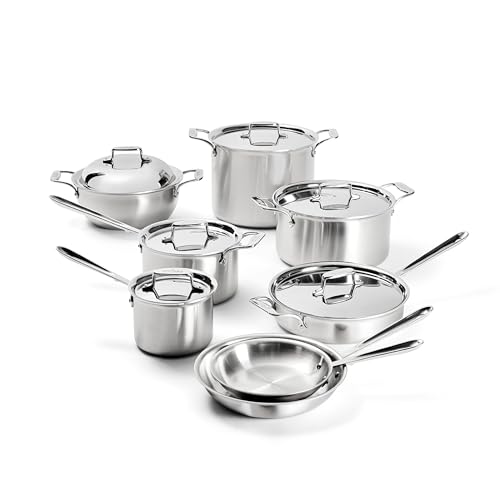
All-Clad D5 Stainless Steel 14-Piece Cooking Set, Made in the USA
14 pieces$1,499.95 Check pricePrices change often


Common questions
Is disc-base cookware bad quality?
No, it is a genuine cost-saving construction choice, not a sign of poor quality. It works fine for pieces like stockpots where the walls rarely need to conduct much heat, since a large volume of liquid distributes heat on its own through convection. It performs worse specifically in skillets and saucepans where food sits close to the walls.
Why does my disc-base saucepan scorch sauce at the top edge?
Disc-base pans have aluminum only in the base, so the walls conduct heat far more slowly than a fully clad pan's walls. As liquid reduces and the level drops, food and sauce sitting near the walls get less even heat than the center of the pan, which is what causes scorching or sticking right at the waterline.
Do I need fully clad construction for a stockpot?
Generally not. A stockpot holds enough liquid volume that convection distributes heat effectively even with disc-base construction, since the walls rarely need to do much conductive work when there is that much water or stock moving inside. Fully clad construction matters far more in skillets, saucepans, and saute pans where food sits closer to the walls.
How can I tell if a pan is fully clad or disc-base before buying?
Check the product listing for terms like fully clad, tri-ply, or five-ply, which indicate an aluminum core through the walls, versus encapsulated base, impact-bonded, or disc bottom, which indicate aluminum only in the base. If the listing is unclear, contacting the manufacturer or checking published spec sheets usually resolves it.
Is it worth paying more for a fully clad stainless set?
It depends on the pieces. Paying more for fully clad skillets and saucepans is usually worth it, since these are where uneven wall heat causes visible cooking problems. Paying extra for a fully clad stockpot is less necessary, since the walls do little conductive work in a large pot filled with liquid.
Can I mix fully clad and disc-base cookware in the same kitchen?
Yes, and many home cooks do this intentionally to save money. Buying fully clad for skillets and saucepans while choosing a disc-base stockpot or pasta pot gets the performance benefit where it matters most without paying a full-cladding premium on pieces where it makes little practical difference.