Best stainless steel skillets
Quick answer
The All-Clad D3 12 Inch Fry Pan with Lid ($149.95) is the best stainless steel skillet for most cooks: it is tri-ply clad through the full pan wall, All-Clad publishes it as oven safe to 600F, and the included lid adds versatility for finishing dishes off the stovetop.

All-Clad D3 Stainless Steel 12" Fry Pan with Lid, Made in the USA
12 inThis All-Clad D3 pan bonds an aluminum core between two layers of stainless steel through the entire pan, walls included, not just the base, so heat spreads evenly across the full cooking surface instead of concentrating in the center. All-Clad publishes a 600F oven-safe rating for D3, roughly 100F above most mid-tier stainless skillets, and the included lid means the same pan can finish a dish covered on the stovetop without needing a separate lid purchase.
The three tiers
Beginner: Best first skillet
someone buying their first genuine stainless steel skillet without committing to a flagship price- Beginner pick
Tramontina Signature Tri-Ply Clad Stainless Steel 10-Inch Frying Pan
10 in$39.95 Check pricePrices change often

The Tramontina Signature Tri-Ply Clad 10 Inch Frying Pan costs $39.95 and uses genuine tri-ply construction, an aluminum core bonded between stainless layers through the full pan wall, the same construction principle used in All-Clad D3 at a fraction of the price. At 10 inches, its flat cooking surface is roughly 8 inches, a practical size for searing a single protein or cooking for one to two people while learning stainless steel technique.
Not for: A cook who wants a lid included or a large enough surface to sear multiple servings at once. This pan is sold without a lid and its size is best suited to smaller portions.
Intermediate: Best value
a cook who wants a larger cooking surface and a lid included, with flagship tri-ply construction- Intermediate pick
All-Clad D3 Stainless Steel 12" Fry Pan with Lid, Made in the USA
12 in$149.95 Check pricePrices change often
The All-Clad D3 12 Inch Fry Pan with Lid at $149.95 gives a roughly 10 inch flat cooking surface, large enough to sear two portions of meat or a full batch of vegetables at once, and the included lid lets the pan finish dishes covered without a separate purchase. All-Clad publishes 600F oven-safe for D3, which covers nearly any home recipe that finishes under a broiler or in a hot oven.
Not for: A cook on a tight budget who mainly needs a single smaller pan for one or two servings. The Tramontina 10 Inch pan above delivers the same clad construction principle at roughly a quarter of the price for a smaller everyday cooking task.
Expert: Performance ceiling
a cook who wants both common skillet sizes covered with matched, flagship-grade construction- Expert pick
All-Clad D3 Stainless Steel Fry Pan Set, 10&12-inch, Made in the USA
12 in$249.99 Check pricePrices change often

The All-Clad D3 Fry Pan Set, 10 and 12 Inch, at $249.99, covers both the smaller size for single servings and the larger size for searing multiple portions, both built with the same tri-ply clad construction and 600F published oven-safe rating as the standalone D3 pans. Owning both sizes means never compromising the pan size to the dish, which matters most to a cook who prepares a wide range of portion sizes throughout the week.
Not for: A cook who only ever cooks for one or two people and rarely needs the larger 12 inch surface. For that use case, the standalone 12 Inch Fry Pan with Lid at $149.95 or the 10 Inch Tramontina at $39.95 covers the actual need without paying for a second pan size that goes unused.
| Product | Price | Diameter | Oven safe |
|---|---|---|---|
| CAROTE 10-Inch Tri-Ply Frying Pan | $25.99 | 10 inches | Manufacturer published, check listing |
| Tramontina Signature Tri-Ply 10-Inch Pan | $39.95 | 10 inches | Manufacturer published, check listing |
| All-Clad D3 12-Inch Fry Pan with Lid | $149.95 | 12 inches | 600F |
| All-Clad D3 Fry Pan Set, 10 and 12 Inch | $249.99 | 10 and 12 inches | 600F |
Why does a stainless steel skillet sear better than nonstick?
A bare stainless cooking surface allows food to form a genuine crust through the Maillard reaction and stick briefly to the pan before releasing naturally once that crust develops, which is exactly the mechanism that builds deep browning and fond for a pan sauce. Nonstick coatings are engineered specifically to prevent that initial adhesion, which is convenient for eggs but works against the browning process a good sear depends on.
This is why cooks who want to make pan sauces after searing meat, deglazing the browned bits left in the pan with wine or stock, reach for stainless or clad cookware rather than nonstick, regardless of how much they otherwise like nonstick for other tasks.
Does pan size affect how well a skillet sears?
Yes, indirectly, through overcrowding. A skillet that is too small for the amount of food being cooked causes the food to steam rather than sear, since the moisture released has nowhere to escape and the pan's temperature drops faster than it can recover between pieces of food. Choosing a 12 inch pan with a roughly 10 inch cooking surface over a 10 inch pan with an 8 inch surface, when cooking two or more portions, keeps enough space between pieces of food for proper searing.
Is a coated nonstick-stainless hybrid pan worth considering?
Some manufacturers, including All-Clad with its D3 Pro Nonstick line, apply a nonstick coating over a tri-ply clad stainless body, aiming to combine even heat distribution with easier food release. This is a reasonable compromise for a cook who wants one pan for both eggs and light searing, but it does not replace a bare stainless skillet for tasks that depend on building fond, since the coating prevents the same browning adhesion a bare stainless surface allows.
How much does the lid actually add to the price?
Comparing similarly sized All-Clad D3 pans, a lid typically adds a modest premium over a lid-less version of the same pan, and buying the set with the lid included is usually cheaper than buying the pan and a separate matching lid individually later. If you already own a universal lid that fits the pan's diameter, skipping the included lid version and buying the cheaper lid-less pan is a reasonable way to save money without losing function.
- Buy with a lid if you regularly cover dishes to finish or steam
- Skip the included lid if a universal lid already covers that diameter
What is the biggest mistake buyers make when choosing a stainless skillet size?
Buying a single 10 inch pan and expecting it to sear for a family of four is the most common sizing mistake, since a 10 inch skillet's roughly 8 inch cooking surface is genuinely suited to one to two servings. Buyers who regularly cook for more people are better served starting with a 12 inch pan, or owning both sizes, as in the All-Clad D3 10 and 12 Inch Fry Pan Set, rather than trying to make one smaller pan cover every meal.
Is a budget tri-ply skillet like CAROTE worth considering as a first stainless pan?
A budget tri-ply skillet in the $25 to $30 range, such as the CAROTE 10 Inch Tri-Ply Stainless Steel Frying Pan, is a genuinely low-risk way to try bare stainless cooking without committing to a flagship price. Because it still uses a bonded aluminum core rather than a single stamped layer, it will exhibit the same fundamental heat distribution behavior as a far more expensive tri-ply pan, so a new stainless steel cook can practice preheating and food release technique on it before deciding whether to invest in a larger or heavier flagship skillet later.
How does a stainless skillet compare to cast iron or carbon steel for searing?
All three can produce a strong sear, but they arrive at it differently. Cast iron and carbon steel rely on high heat capacity and a built seasoning layer, while a stainless skillet relies on the aluminum core in tri-ply construction to distribute heat evenly across a bare metal surface that browns food through direct contact rather than through a seasoned coating. A stainless skillet also has the advantage of being dishwasher safe and requiring no seasoning maintenance, which makes it the lower-effort choice for a cook who wants searing capability without the ongoing care routine cast iron and carbon steel require.
The tradeoff runs the other way too: a well-seasoned cast iron or carbon steel pan develops a natural nonstick surface that a bare stainless skillet never will, so many kitchens end up keeping both, using stainless specifically for pan sauces and dishes that benefit from deglazing, and cast iron or carbon steel for a longer, undisturbed sear.
How we chose
This page is researched from published manufacturer specifications, including construction type (tri-ply clad versus a coated stainless surface), rim diameter and oven-safe temperature rating, compared against catalog pricing. No in-person cooking or lab testing of these pans informed this page.
We excluded coated nonstick-stainless hybrid pans from the main tiers, since a genuinely bare stainless cooking surface, the kind that browns and builds fond for a pan sauce, is the defining reason to choose a stainless steel skillet over nonstick in the first place. Pans described as nonstick-coated stainless are noted separately where relevant, since they serve a different cooking purpose.
Buying tips
What size stainless steel skillet should you buy?
A skillet is sold by its rim diameter, but the flat cooking surface that actually touches food is roughly 2 inches smaller because of the sloped sidewalls. A 10 inch skillet has close to an 8 inch usable surface, suited to one to two servings, while a 12 inch skillet has closer to a 10 inch surface, better for searing multiple portions or larger cuts at once. When comparing two pans by rim diameter alone, remember that a two-inch difference in rim size can translate to a meaningfully larger jump in actual usable surface area, since area scales with the square of the radius.
Is tri-ply clad worth it in a single skillet, or only in a full set?
It matters just as much, if not more, in a single skillet, because a skillet is used primarily for searing and browning, the exact tasks where uneven heat distribution shows up as hot spots and inconsistent cooking. A disc-base skillet, where aluminum sits only in a puck welded to the bottom, can develop an uneven ring pattern when searing, while tri-ply clad construction spreads heat evenly across the entire cooking surface.
Should you buy a skillet with a lid included?
A lid is worth paying for if you regularly finish dishes covered on the stovetop, such as steaming vegetables in a small amount of liquid or keeping a seared protein warm while a sauce reduces separately. Pans sold without a lid, like the Tramontina 10 Inch, are usually priced lower and are a reasonable choice if you already own a universal lid that fits multiple pan sizes.
What oven-safe rating matters for a skillet specifically?
A skillet is more likely than a saucepan or stockpot to be finished in the oven or under a broiler, since many stovetop-to-oven recipes, like a seared chicken thigh or a frittata, start on the burner and finish overhead. All-Clad publishes 600F oven safe for D3, the highest commonly available rating on a stainless skillet, while many mid-tier tri-ply skillets are rated closer to 500F, still enough for the vast majority of recipes.
Does handle design affect how a stainless skillet performs?
A riveted stainless handle stays structurally sound at high heat and under a broiler, unlike some plastic or composite handles that limit the whole pan's oven-safe rating regardless of how the pan body is constructed. A longer handle also gives more leverage for the wrist-flick motion used to toss food in the pan without a spatula, which matters more on a heavier 12 inch skillet than on a lighter 10 inch one.
Other options worth knowing about
- Tramontina
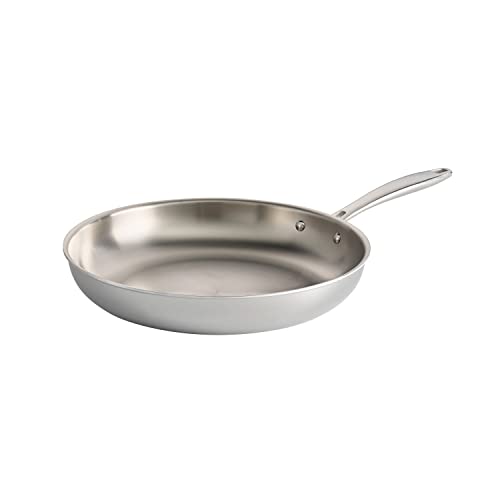
Tramontina Signature Tri-Ply Clad Stainless Steel 12-Inch Large Frying Pan
12 in$49.95 Check pricePrices change often - All-Clad
All-Clad D5 Stainless Steel 12" Fry Pan, Made in the USA
12 in$199.95 Check pricePrices change often



Common questions
What is the best stainless steel skillet overall?
The All-Clad D3 12 Inch Fry Pan with Lid at $149.95 is the best overall pick. It is tri-ply clad through the full pan wall, carries All-Clad's published 600F oven-safe rating, and includes a lid for finishing dishes covered.
Is a cheaper tri-ply skillet like Tramontina as good as All-Clad?
For everyday searing and sauteing, yes, the underlying construction principle, an aluminum core bonded through the full pan wall, is the same. All-Clad's advantages are mainly a higher published oven-safe rating, US manufacturing and long-term warranty support, which matter more to a cook who uses the pan daily for years.
What size stainless skillet is best for searing a steak?
A 10 to 12 inch skillet is the standard recommendation for searing a single steak, giving enough room around the meat for proper browning without overcrowding. For two or more steaks at once, a 12 inch pan with its roughly 10 inch cooking surface is the safer choice to avoid steaming instead of searing.
Why does food stick to my stainless steel skillet even though it is expensive?
Sticking on stainless steel is almost always a technique issue, not a construction defect: the pan needs to be properly preheated for one to two minutes before oil is added, and food should not be moved until a crust has formed and released naturally. This applies equally to budget and flagship stainless skillets.
Do I need both a 10 inch and 12 inch stainless skillet?
Only if your portion sizes vary meaningfully, such as cooking for one person some days and a family on others. A single 12 inch pan can handle smaller portions adequately, so buying both sizes is more about convenience and matching pan to task than a strict requirement.
Is 600F oven-safe actually necessary for a home cook?
For most recipes, no, since typical oven-finished dishes fall in the 400F to 450F range. A 600F rating like All-Clad D3's becomes useful specifically for high-heat broiler finishing or recipes that intentionally call for very high oven temperatures, which is a smaller subset of home cooking.