What size pan for how many portions
Quick answer
Four portions seared need about 100 square inches of flat cooking surface, which means a 14 inch skillet rather than a 12 inch one. A skillet is sold by its rim diameter and its flared walls make the flat cooking surface roughly two inches smaller, so a "12 inch" skillet gives you about a 10 inch cooking surface, or 79 square inches.
The area arithmetic is exact. How much area one portion needs in order to brown is a kitchen convention, and the figure used here is stated openly so you can adjust it.
A skillet is sold by its rim. The flat cooking surface is what actually browns food, and on a flared pan it is about two inches smaller across.
This leaves 28 square inches per portion, which is enough space for moisture to escape and browning to happen.
Crowding is the single most common cooking mistake. Below about 20 square inches per portion the pan temperature drops, moisture cannot escape fast enough, and the food steams in its own liquid instead of browning.
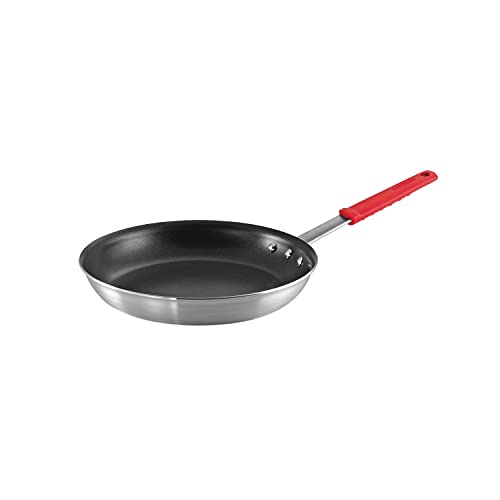
Skillets, cheapest first
Prices come from live listings and move constantly. Use these to see the shape of the category, then check the current figure.
- Lodge
Lodge Pre-Seasoned Cast Iron Skillet, PFAS-Free, 10.25 Inches
10.25 in$24.90 Check pricePrices change often - CAROTE
CAROTE 12 Inch Classic Granite Non Stick Black Frying Pan, PFOA-Free
12 in$27.99 Check pricePrices change often - Lodge
Lodge Pre-Seasoned Cast Iron Skillet with Silicone Handle Holder, 12 Inches
12 in$34.90 Check pricePrices change often - Lodge
Lodge Pre-Seasoned Cast Iron Skillet Set, 8, 10.25 and 12 Inches
12 in$64.90 Check pricePrices change often - All-Clad
All-Clad D3 Stainless Steel Fry Pan Set, 10&12-inch, Made in the USA
12 in$249.99 Check pricePrices change often


Common questions
Why is a 12 inch skillet not 12 inches of cooking surface?
Because cookware is measured across the top rim, and a skillet has flared walls so the flat base is smaller. The difference is usually about two inches, so a 12 inch skillet gives roughly a 10 inch cooking surface. That is 79 square inches rather than 113, a difference of about 30 percent, and it is why a pan that looks big enough often is not.
What actually happens when a pan is crowded?
The food releases moisture faster than the pan can drive it off, so the surface sits in liquid at about the boiling point of water. Browning reactions need a much hotter, drier surface than that, so the food goes grey and soft instead of crusted. Adding heat does not fix it, because the limit is evaporation rate, not burner output.
Is a saute pan better than a skillet for this?
For a given rim diameter, yes, in terms of capacity. Straight sides mean almost no loss from rim to base, so a 12 inch saute pan gives close to a 12 inch cooking surface. Flared skillet walls exist for a different reason: they let you toss food and they make it easy to get a spatula under things, which is worth the lost area for a lot of cooking.
Should I just buy the biggest pan available?
No. A pan much larger than the burner heats unevenly, with a hot ring in the middle and cool edges, and a very large pan is heavy and awkward to move and store. Match the pan to the batch you normally cook. A second medium pan on a second burner beats one oversized pan for most households.
Does this change on induction?
It changes for the better, because an induction ring heats the whole magnetic base rather than a gas flame heating a central spot. The usable area gets closer to the true base area. The crowding arithmetic is unchanged: surface area per portion is about evaporation, not about how the heat arrives.