Best nonstick cookware sets
Quick answer
The T-Fal Ultimate Hard Anodized 17-Piece Set ($229.99) is the best nonstick cookware set for most kitchens: hard-anodized aluminum resists warping better than stamped aluminum, and T-Fal publishes it as oven safe to 400F with the lid rated to 350F.

T-Fal Ultimate Hard Anodized Nonstick Pots and Pans Set 17 Piece, Nonstick Cookware Set with Fry Pan, Saucepans, Saute-Pan, Griddle, Dishwasher Safe, Onyx
17 piecesHard-anodized aluminum is electrochemically treated to be significantly harder and more scratch-resistant than the stamped aluminum used in budget nonstick sets, which means it holds its shape and its coating longer under repeated heating and cooling. T-Fal publishes this 17-piece set as oven safe to 400F, with the lid rated separately to 350F, and 17 pieces covers a full rotation of pans, pots and lids for the price.
The three tiers
Beginner: Best first set
someone who wants the lowest-cost way to cover every pan size in a first kitchen
The Astercook 21-Piece Ceramic Cookware Set costs $59.99 and uses a ceramic nonstick coating rather than PTFE, which some buyers prefer for peace of mind since ceramic coatings do not use the PFAS-related chemistry that PTFE coatings rely on. Detachable handles let the pans nest for storage, and 21 pieces, including lids and utensils, covers a first kitchen without a large upfront cost.
Not for: Anyone planning to cook at high heat regularly. Ceramic nonstick coatings, like PTFE, are not built for aggressive searing, and they tend to lose their nonstick performance faster than hard-anodized PTFE coatings when exposed to high heat repeatedly.
Intermediate: Best value
a cook who wants a larger, more durable nonstick set without paying hard-anodized flagship prices- Intermediate pick
CAROTE 26pcs Pots and Pans Set, Nonstick Cookware Sets
26 pieces$139.99 Check pricePrices change often

The CAROTE 26-Piece Nonstick Set at $139.99 sits between budget ceramic sets and hard-anodized flagship sets, giving a large piece count with a PTFE-based nonstick coating over a stamped aluminum body. It covers a broader range of pan and pot sizes than most sets under $100, which suits a household that entertains occasionally or cooks for more than two people.
Not for: A cook who wants maximum coating longevity. Stamped aluminum bodies are softer than hard-anodized aluminum and are more prone to warping under thermal stress over years of use, which can shorten how long the nonstick coating stays effective.
Expert: Performance ceiling
a cook who wants the most durable nonstick construction available and cooks with nonstick pans dailyThe T-Fal Ultimate Hard Anodized 17-Piece Set at $229.99 uses hard-anodized aluminum, which is harder and more warp-resistant than the stamped aluminum used in most budget nonstick sets, so the coating stays bonded evenly over more years of daily use. T-Fal publishes a 400F oven-safe rating for the pans, with the lid rated to 350F, both meaningfully higher than many budget nonstick sets.
Not for: A cook who wants to sear meat hard or finish a dish under a broiler above 400F. No matter how durable the underlying aluminum is, PTFE nonstick coatings are published at 400F to 500F and begin breaking down near the top of that range, so this set is still not a substitute for stainless or cast iron at high heat.
| Product | Price | Coating | Oven safe |
|---|---|---|---|
| Astercook 21-Piece Ceramic Set | $59.99 | Ceramic, PFAS-related chemistry free | Manufacturer published, check listing |
| CAROTE 26-Piece Nonstick Set | $139.99 | PTFE over stamped aluminum | Manufacturer published, check listing |
| T-Fal Ultimate Hard Anodized 12-Piece Set | $159.99 | PTFE over hard-anodized aluminum | 400F (lid 350F) |
| T-Fal Ultimate Hard Anodized 17-Piece Set | $229.99 | PTFE over hard-anodized aluminum | 400F (lid 350F) |
How is hard-anodized aluminum different from regular nonstick aluminum?
Hard anodizing is an electrochemical process that thickens and hardens the natural oxide layer on aluminum, making the metal underneath the nonstick coating significantly more resistant to warping, denting and scratching than stamped aluminum. This matters because a warped pan base no longer sits flat on a burner, which creates uneven heating that can cause food to stick even on an otherwise intact nonstick coating.
Stamped aluminum, used in most budget nonstick sets under $100, is lighter and cheaper to produce but more prone to warping over years of thermal cycling, which is one reason budget nonstick sets often feel like they perform worse after a year or two even when the coating itself still looks intact.
Is ceramic nonstick actually safer than PTFE?
Ceramic coatings are marketed around avoiding PTFE and the broader PFAS chemical family, which appeals to buyers concerned about that chemistry specifically. Both coating types are considered safe for normal cooking use when not overheated empty on high heat, and the main practical difference for most cooks is not safety but durability: ceramic coatings generally show reduced nonstick performance sooner than well-maintained PTFE coatings.
Buyers choosing between the two should weigh which tradeoff matters more to them personally: PTFE for a longer-lasting nonstick surface under normal care, or ceramic for a coating built around avoiding a specific class of chemical compound, understanding that the ceramic option will likely need replacing sooner if used at the same frequency and heat level.
What is the biggest mistake that kills a nonstick pan early?
Preheating a nonstick pan empty on high heat before adding oil or food is the most commonly cited cause of early coating failure in owner reports. PTFE coatings are published as safe up to 400F to 500F, but an empty pan on a high burner can exceed that range within a couple of minutes, well before food or liquid is added to moderate the temperature. Adding oil before heating and keeping the burner at medium or lower extends coating life substantially.
- Avoid: preheating empty on high heat
- Avoid: metal utensils and abrasive scouring pads
- Avoid: stacking pans without a protective liner between them
- Avoid: nonstick cooking spray buildup, which can leave a sticky residue over time
Why do nonstick sets come in such large piece counts like 21 or 26?
Large piece counts in nonstick sets are partly a genuine coverage benefit, since nonstick pans are inexpensive enough per unit that manufacturers can bundle multiple sizes profitably, and partly a marketing device, since several of the pieces in a 21 or 26 piece set are lids, spatulas or small prep bowls rather than additional cooking vessels. Buyers should count the actual pots and pans separately from lids and tools before comparing sets by piece count alone.
This is worth doing math on before buying: divide the total price by the number of actual pots and pans, not the advertised piece count, and compare that per-pan price across sets. It often reveals that a smaller, hard-anodized set costs a similar amount per pan as a larger stamped aluminum set, once lids and tools are excluded from the count.
When should nonstick be replaced instead of repaired?
There is no realistic way to repair a scratched or flaking nonstick coating, so once visible scratching exposes the base metal, or food noticeably sticks to areas that used to release cleanly, replacement is the only option. Because nonstick coatings have a finite lifespan by design, budgeting to replace a nonstick pan every one to three years, depending on use frequency, is a more realistic expectation than treating it as a permanent purchase the way stainless or cast iron can be.
Do nonstick pans need to be washed differently than stainless?
Nonstick pans should generally be hand washed with a soft sponge, since abrasive scouring pads and steel wool scratch the coating even on a durable hard-anodized body. Many manufacturers list their nonstick cookware as dishwasher safe, but hand washing extends coating life by avoiding the harsher detergents and the jostling against other dishes that can happen in a dishwasher cycle, and letting the pan cool to room temperature before washing avoids warping the aluminum body underneath the coating.
Storing nonstick pans also matters more than most buyers expect. Stacking a nonstick pan directly inside another pan lets the rim of the top pan scratch the coating of the one underneath every time the stack is disturbed, so a thin cloth, paper towel or a purpose-made pan protector between stacked pieces prevents avoidable coating damage during simple storage rather than actual cooking.
How we chose
This page is researched from published manufacturer specifications, including coating type (PTFE or ceramic), body construction (stamped versus hard-anodized aluminum) and oven-safe temperature ratings, compared against catalog pricing. No hands-on cooking or lab testing of coating durability was performed for this page.
We favored hard-anodized construction over stamped aluminum wherever the price gap was reasonable, because hard-anodized aluminum resists warping better over repeated heating cycles, which is the main factor that determines how long a nonstick coating stays effective. Ceramic coatings were included as a distinct beginner option for buyers who specifically want to avoid PTFE-based chemistry.
Buying tips
PTFE or ceramic nonstick, which should you buy?
PTFE-coated nonstick, the traditional coating used by brands like T-Fal and Calphalon, is generally more durable over time and tolerates a slightly wider published temperature range. Ceramic coatings, used in sets like the Astercook 21-Piece Set, avoid PTFE-related chemistry entirely, which matters to some buyers, but ceramic coatings typically lose their nonstick effectiveness faster with repeated high-heat use. Neither coating is built for aggressive searing.
How long does a nonstick coating actually last?
Most nonstick coatings, PTFE or ceramic, begin losing effectiveness after one to three years of regular use, faster if metal utensils are used or the pan is regularly heated empty before adding oil. Hard-anodized aluminum bodies extend the coating's effective life somewhat by resisting the warping that can crack a coating prematurely, but no nonstick coating is designed to last indefinitely, unlike bare stainless or cast iron.
What oven temperature is safe for a nonstick set?
Check both the pan and the lid separately. T-Fal publishes 400F for its Ultimate Hard Anodized pans but rates the lid only to 350F, since lids often use different handle materials with a lower heat tolerance. PTFE coatings generally are published in the 400F to 500F range and begin breaking down near the top of that range, so treat any nonstick set as unsuitable for high-heat broiler finishing regardless of brand.
Is a larger nonstick set actually a better value per pan?
Not automatically. Compare the price per actual cooking vessel, not the advertised piece count, since a 26-piece set that includes several lids, a steamer basket and prep tools may cost more per usable pan than a smaller 12-piece set built from the same materials. This is especially worth checking when comparing across brands, since piece-count marketing varies widely in how generously it counts lids and tools as full pieces.
Should metal utensils ever touch a nonstick pan?
No. Metal utensils scratch both PTFE and ceramic coatings, creating small breaks where food can stick and where the coating can flake over time. Silicone, wood or nylon utensils are the standard recommendation across every nonstick brand covered on this page, and using them consistently is one of the simplest ways to extend a nonstick set's working lifespan.
Is a heavier nonstick pan always a hard-anodized one?
Not necessarily, so check the listing rather than judging by weight or feel alone. Hard-anodized aluminum can actually feel similar in weight to stamped aluminum of the same size, since anodizing changes the surface hardness of the metal rather than adding significant mass. The manufacturer specification, not the pan's heft in your hand, is the reliable way to confirm whether a set uses hard-anodized construction.
Other options worth knowing about
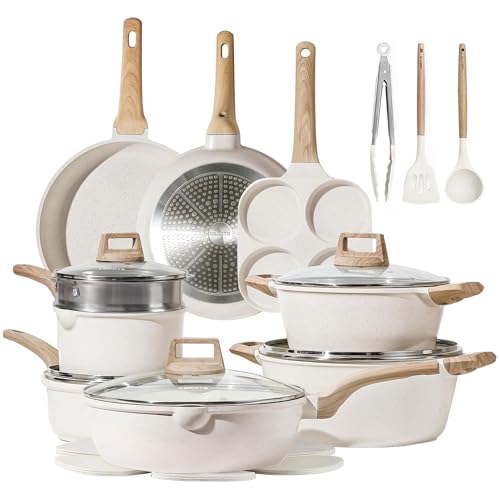
- CAROTE
CAROTE 21pcs Pots and Pans Set Non Stick, Detachable Handle Cookware, Black
21 pieces$59.99 Check pricePrices change often - CAROTE
CAROTE 21pcs Ceramic Cookware Set, Pots and Pans Set
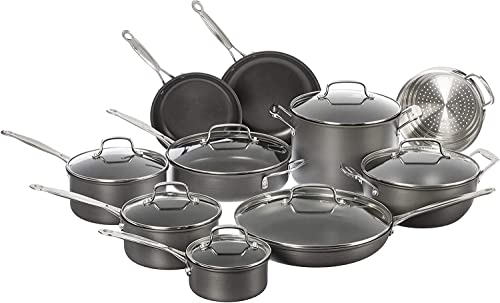
21 pieces$79.99 Check pricePrices change often - Calphalon
Calphalon Classic Hard-Anodized Nonstick Cookware Kitchen Essentials Set
$119.27 Check pricePrices change often - CAROTE
CAROTE 21pcs Pots and Pans Set, Nonstick Cookware Sets, with Egg Pan
21 pieces$189.99 Check pricePrices change often


Common questions
What is the best nonstick cookware set overall?
The T-Fal Ultimate Hard Anodized 17-Piece Set at $229.99 is the best overall pick. Hard-anodized aluminum resists warping better than stamped aluminum, which extends how long the nonstick coating performs well, and T-Fal publishes a 400F oven-safe rating for the pans.
Is ceramic nonstick better than PTFE nonstick?
Ceramic coatings avoid PTFE and PFAS-related chemistry, which matters to buyers who prioritize that specifically. For raw durability and how long the nonstick surface performs well under regular use, PTFE coatings, especially over hard-anodized aluminum, generally outlast ceramic coatings in owner reports.
How often should a nonstick cookware set be replaced?
Most nonstick coatings, PTFE or ceramic, show reduced performance after one to three years of regular use, sooner if metal utensils or high heat are used often. There is no repair option once a coating scratches or flakes, so replacement on that timeline should be expected and budgeted for rather than treated as a failure.
Can nonstick cookware go in the oven?
Yes, within the published limit. T-Fal rates its Ultimate Hard Anodized pans to 400F with the lid separately rated to 350F. Most nonstick PTFE coatings are published in the 400F to 500F range generally, and exceeding that range risks the coating breaking down, so always check the specific pan and lid rating before an oven-finished recipe.
Why does food start sticking to an old nonstick pan?
Sticking on an aging nonstick pan usually means the coating has worn thin from metal utensil scratches, abrasive cleaning, or repeated high-heat exposure, all of which physically or chemically degrade the nonstick surface over time. This wear is permanent and cannot be restored, which is why nonstick pans are treated as a wear item rather than a lifetime purchase.
Is a 26-piece nonstick set better than a 12-piece set?
Not necessarily better, just larger in piece count, and often at a similar or lower price for stamped aluminum construction. A 12-piece hard-anodized set like the T-Fal Ultimate Hard Anodized 12-Piece Set at $159.99 may offer better long-term coating durability than a 26-piece stamped aluminum set, even with fewer total pieces.