Induction cooking and cookware compatibility
Quick answer
Induction cooktops work by inducing an electrical current directly in a magnetic base, so only ferromagnetic cookware, cast iron, carbon steel, enameled cast iron, and stainless with a magnetic exterior, works; a fridge magnet should grip the pan's base firmly, and most hobs need roughly a 4.3 inch (110 mm) flat magnetic area to even detect the pan.
The induction mechanism, magnetic material requirements and minimum base size figure are standard published specifications.
| Material | Magnetic | Works on induction |
|---|---|---|
| Cast iron | Yes | Yes |
| Carbon steel | Yes | Yes |
| Enameled cast iron | Yes (iron core) | Yes |
| Stainless, ferritic (430) | Yes | Yes |
| Stainless, austenitic (304, 18/10) | No | No, unless bonded to a magnetic base layer |
| Aluminum (bare) | No | No |
| Copper (bare) | No | No |
| Glass | No | No |
| Stoneware | No | No |

How induction actually heats the pan
Induction cooking works by generating a rapidly alternating magnetic field beneath the glass cooktop, which induces electrical currents directly inside the metal of a magnetic pan base. Those induced currents meet the electrical resistance of the metal and generate heat directly inside the pan itself, rather than heating a burner element that then transfers heat to the pan the way gas or standard electric cooktops do. This is why an induction hob's glass surface stays comparatively cool even while the pan on it gets hot: the cooktop itself is not the heat source, the pan is.
The mechanism only works with a ferromagnetic base, meaning a metal that responds to a magnetic field, because non-magnetic metals do not couple with the alternating field strongly enough to generate meaningful current. This single requirement is the entire induction compatibility question in a nutshell: is the base of the pan magnetic or not.
Which cookware materials actually work
Cast iron and carbon steel are both naturally ferromagnetic and work on induction without any modification, which is part of why both materials have seen a resurgence alongside induction cooktop adoption. Enameled cast iron also works, since the enamel coating is just a glassy surface layer and the ferromagnetic iron underneath still responds to the field normally.
Aluminum, copper, glass and stoneware do not work on induction at all, regardless of how well they otherwise conduct or hold heat, because none of them are magnetic. This is a hard cutoff, not a performance penalty: a pure aluminum or copper pan placed on an induction hob will simply not heat up, since there is no ferromagnetic material for the field to induce current in.
Why stainless steel is not a simple yes or no
Stainless steel cookware compatibility depends entirely on which grade of stainless sits in the base, and this is the single most common point of confusion for shoppers. Austenitic 18/10 stainless, grade 304, the type used for most cookware's visible cooking surface because of its shine and corrosion resistance, is not magnetic and will not work on induction by itself. Ferritic 430 stainless, by contrast, is magnetic and does work.
Induction-compatible stainless cookware solves this by bonding a layer of magnetic 430 stainless, or another ferromagnetic disc, into the base of the pan, underneath or blended with the visible 304 surface. This is why some multi-ply stainless sets are labeled induction-ready while others of seemingly similar quality are not: the difference is invisible from the top and only shows up in the base construction.
The fridge-magnet test explained
The quickest and most reliable way to check induction compatibility without owning an induction hob is to press an ordinary refrigerator magnet against the flat base of the pan. A pan that will work on induction gives the magnet a firm, noticeable grip, since the base contains enough ferromagnetic material to couple strongly with a magnetic field. A pan that will not work gives a weak grip or none at all, since the base has little or no magnetic material for the field to act on.
This test works because it relies on the same physical property, ferromagnetism, that the induction cooktop itself depends on. A pan does not need to be tested on an actual induction burner to know whether it will work; the magnet answers the question directly and for free.
Base size and flatness matter as much as the material
Being magnetic is necessary but not sufficient. Most induction hobs also require a minimum flat magnetic area, roughly 4.3 inches (110 mm), before the cooktop's sensor will even recognize that a pan is present and begin heating. A small saucepan or a pan with a narrow, non-flat base can be made of the right material and still fail to trigger the hob if the contact area is too small.
Flatness is the second requirement. Induction relies on close, even contact between the pan base and the cooktop surface to transfer the magnetic field efficiently, so a warped pan base, a pan with feet or ridges, or a round-bottomed wok will not couple properly even if the metal itself is fully ferromagnetic.
Converting cookware that does not natively work
An interface disc, a flat ferromagnetic plate placed between a non-compatible pan and the induction cooktop, lets copper, aluminum or glass cookware be used on an induction hob by giving the field something magnetic to induce current in. The disc itself heats up and transfers that heat to the pan sitting on top of it, though this adds an extra layer between burner and pan and generally heats less efficiently and less evenly than cookware that is natively induction-compatible.
For most home cooks, buying cookware with a genuinely magnetic base, rather than relying on an interface disc as a permanent workaround, gives more consistent results and avoids the efficiency loss of heating through an intermediate plate.
Gear for this job
- Merten & Storck
Merten & Storck 8" Pre-Seasoned Carbon Steel Frying Pan Skillet
8 in$29.99 Check pricePrices change often - All-Clad
All-Clad D5 Stainless Steel 5-Piece Cooking Set, Made in the USA
5 pieces$499.95 Check pricePrices change often - All-Clad
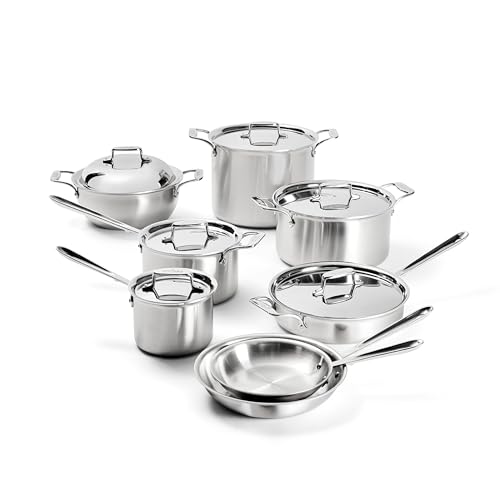
All-Clad D5 Stainless Steel 14-Piece Cooking Set, Made in the USA
14 pieces$1,499.95 Check pricePrices change often


Common questions
How do I test if a pan works on induction without buying an induction hob?
Hold a standard refrigerator magnet against the flat base of the pan. If the magnet grips firmly and resists being pulled off, the base is magnetic enough to work on induction. If the magnet barely holds or falls off, the pan will not heat on an induction cooktop, regardless of what material the visible cooking surface is made from.
Why doesn't my stainless steel pan work on induction?
Most visible stainless cooking surfaces are 18/10, or grade 304, stainless steel, which is austenitic and not magnetic. Unless the manufacturer has bonded a separate magnetic layer, often 430 stainless, into the base specifically for induction compatibility, a 304 stainless pan will not respond to an induction hob's magnetic field at all.
What size does a pan base need to be for induction?
Most induction hobs need roughly a 4.3 inch (110 mm) flat magnetic area on the pan base just to detect that a pan is present at all, before any heating even starts. The base also needs to sit flat against the cooktop surface, which is why a round-bottomed wok generally will not work on a flat induction hob without a special adapter ring.
Can I use aluminum or copper cookware on an induction cooktop?
Not on their own. Aluminum and copper are excellent heat conductors but neither is magnetic, so neither will generate current or heat up on an induction cooktop by itself. Some aluminum or copper cookware is made induction-compatible by adding a magnetic stainless steel base layer, but bare aluminum or copper pans will not work.
Does enameled cast iron work on induction?
Yes. The enamel coating on enameled cast iron dutch ovens and skillets is a glassy surface finish, not a barrier to the induction field, and the ferromagnetic cast iron underneath still responds normally. Enameled cast iron is one of the more reliable induction-compatible choices across price points.
Will a round-bottomed wok work on a flat induction cooktop?
Generally no, even if the wok itself is made from a magnetic material like carbon steel. Induction hobs need the pan's base to sit flat against the cooktop surface to couple with the magnetic field efficiently, and a round bottom cannot make that flat, even contact without a specialized flat-bottomed wok or an adapter ring designed for induction use.