Best santoku knives
Quick answer
The best all-around santoku knife is the Mercer Culinary Genesis 7 Inch at $39.95, a flat-profile knife built for the rocking-free, up-and-down chopping style santoku knives are designed around.

Mercer Culinary M20707 Genesis 7-Inch Santoku Knife,Black
7 inThe Mercer Culinary Genesis 7 Inch is a mainstay in professional kitchens and culinary schools for good reason: it delivers the flatter blade profile and shorter length that define a santoku, at a price that makes it an easy recommendation. It handles the santoku's core job, straight up-and-down chopping of vegetables and boneless proteins, better than knives that are simply chef knives renamed for marketing.
The three tiers
Beginner: Best budget option
someone curious about the santoku shape who does not want to spend much to try it- Beginner pick
Imarku Santoku Knife 7 Inch Japanese Style Sharp Edge Design Kitchen Knife
7 in$28.39 Check pricePrices change often
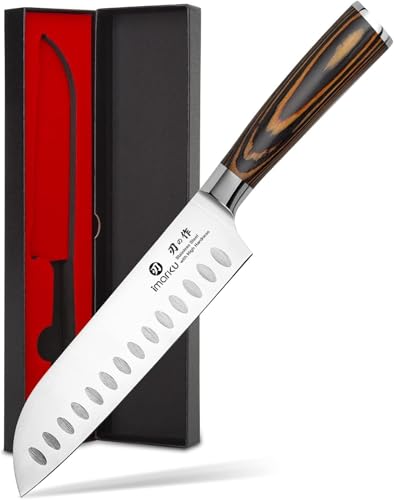
The imarku Santoku 7 Inch is priced at $28.39 and gives a genuine first look at the santoku profile: a flatter edge than a chef knife and a shorter, more maneuverable blade that suits smaller hands and smaller cutting boards. Because the specific steel composition for this line is not confidently confirmed here, judge it as an entry-level knife rather than expecting the edge retention of a more established, fully documented line.
Not for: anyone who wants a knife with a well-documented steel specification to plan sharpening intervals around
Intermediate: Best all-around
a home cook who wants a genuine professional-grade santoku without paying premium Japanese knife prices- Intermediate pick
Mercer Culinary M20707 Genesis 7-Inch Santoku Knife,Black
7 in$39.95 Check pricePrices change often
Mercer Culinary built its reputation supplying culinary schools, and the Genesis 7 Inch santoku reflects that: a full tang, a comfortable ergonomic handle, and a blade ground for the santoku's signature flat, up-and-down chopping motion rather than the rocking motion a chef knife is designed around. At $39.95 it is priced closer to a budget knife than a premium one but performs like a knife built for daily professional use.
Not for: someone specifically chasing a harder, longer-holding Japanese steel and willing to pay more for it
Expert: Best step up
someone who wants a sharper-feeling santoku and is comfortable spending more for it- Expert pick
HOSHANHO 7 Inch Japanese Chef Knife, Ultra Sharp Kitchen Santoku Knives
7 in$64.99 Check pricePrices change often

The HOSHANHO 7 Inch is described as an ultra-sharp Japanese-style chef knife at $64.99, positioned above the Genesis in price and marketed around a keener edge. Because the specific steel type is not confidently confirmed here, this recommendation is about the category rather than an asserted hardness figure: expect a thinner, sharper-feeling edge in exchange for more careful handling than a typical Western-ground santoku.
Not for: anyone who wants a fully documented steel and hardness spec before buying, or anyone who plans to handle the knife roughly
| Knife | Price | Steel | Notes |
|---|---|---|---|
| imarku Santoku 7 Inch | $28.39 | Not independently confirmed | Budget entry point |
| Mercer Culinary Genesis 7 Inch | $39.95 | High-carbon stainless (full spec not asserted) | Professional-grade, culinary school standard |
| HOSHANHO 7 Inch | $64.99 | Not independently confirmed | Marketed for a sharper, thinner edge |
What exactly is a santoku and how does it differ from a chef knife
Santoku translates roughly to three virtues, referring to its suitability for slicing, dicing, and mincing. Its defining features are a flatter cutting edge with less curve than a chef knife and a shorter, typically 5 to 7 inch blade. That flatter profile is built for a straight, up-and-down chopping motion against the board rather than the rocking motion a curved chef knife blade is designed to support.
The shorter length also makes a santoku easier to control for cooks with smaller hands or smaller cutting surfaces. It is not a smaller chef knife with a different name; the flatter geometry genuinely changes how the knife wants to be used, and cooks who try to rock-chop with a santoku the way they would with a chef knife often find it less comfortable than expected.
Does a santoku need to be made from harder steel to be a good santoku
No. Steel hardness in a santoku follows the same rules as any other kitchen knife: harder steel around 60 to 64 HRC holds a keener edge longer but chips more easily and needs a whetstone, while softer steel around 55 to 58 HRC dulls, in the sense of rolling, sooner but comes back quickly on a honing rod and tolerates more careless handling. A well-made santoku in either steel range does its job; the choice is about maintenance preferences, not about which steel makes a knife more authentically a santoku.
- Softer steel santoku (about 55 to 58 HRC): forgiving, honing rod friendly, good for a first santoku
- Harder steel santoku (about 60 HRC or above): sharper feeling, needs a whetstone, better for an experienced user
Is a shorter santoku blade a downside for bigger cutting jobs
For breaking down a large squash or a whole watermelon, yes, a shorter 5 to 7 inch santoku blade is more limiting than a full 8 inch chef knife, simply because there is less blade length to complete a single pass through a large item. For the bulk of everyday prep, dicing onions, mincing garlic, slicing cucumbers, the shorter length is rarely a limitation and is often an advantage in a smaller kitchen or for someone with smaller hands.
Why do some santoku knives cost twice as much as others
Price differences among santoku knives usually come down to steel quality, construction method, and brand positioning, the same drivers as any other knife category. A knife like the Mercer Culinary Genesis earns its price through a documented track record in professional and culinary school settings and a full tang construction, while a pricier option marketed around a sharper edge is often making a claim about thinner geometry or harder steel that is worth confirming before assuming it is automatically better for your use.
As with any knife purchase, the safest approach is to weigh a specific, documented claim, a named steel type, a published hardness figure, a known construction method, against a general marketing phrase like premium or professional grade, which carries no verifiable meaning on its own.
How should I care for a santoku day to day
Hand wash and dry it immediately after each use, never cut on glass, stone, or ceramic, all of which dull an edge almost immediately, and match maintenance to the steel: a honing rod for softer steel, a whetstone for harder steel. A blunt santoku is just as dangerous as a blunt chef knife, since a dull edge skates off food instead of biting into it, so keep it maintained on the same schedule you would any other primary knife.
Can a santoku replace a chef knife entirely in a small kitchen
For many small kitchens, yes, especially one built around vegetables, boneless proteins, and a flat cutting board rather than large roasts or big produce like whole squash. A santoku's shorter length and flatter profile suit a compact counter and a cook who values maneuverability over reach. What it gives up is the ability to rock-chop efficiently through a large pile of herbs or handle a wide item like a watermelon in one continuous motion, tasks where a full-length chef knife still has a real advantage.
If your kitchen only has room to store one knife well, and your cooking leans toward smaller-scale daily prep rather than large batch cooking, a good santoku like the Mercer Culinary Genesis can reasonably serve as that single knife. Most kitchens with the space for two knives are still better served keeping both a chef knife and a santoku on hand, since each covers a gap the other leaves.
How we chose
This guide is researched from published manufacturer specifications and owner reports rather than in-person evaluation. A santoku is defined by its shape and use case more than any single steel type, so this guide weighs blade profile, length, and how well each knife matches the santoku's flat, up-and-down chopping motion, alongside whatever steel data each manufacturer confidently publishes.
Where a specific product's steel composition is not confirmed with confidence, this guide describes it in general category terms rather than asserting a specific hardness number, which is why the beginner and expert picks here are judged on design and positioning rather than a claimed Rockwell figure.
Buying tips
What is a santoku actually good for that a chef knife is not
A santoku's flatter blade profile is built for a straight up-and-down chopping motion rather than the rocking motion a curved chef knife blade encourages. This makes it well suited to chopping vegetables into uniform pieces on a flat board and to smaller hands or smaller kitchens where a full-length chef knife feels unwieldy. It is not a replacement for every task a chef knife handles, particularly ones that benefit from a rocking motion or a longer reach.
Do santoku knives need different sharpening than a chef knife
The sharpening approach follows the steel, not the shape. A santoku made from softer steel around 55 to 58 HRC responds well to a honing rod for routine maintenance, the same as a similar-steel chef knife. A santoku made from harder steel needs a whetstone instead. The santoku shape itself does not change the maintenance routine; the steel inside it does, so check the manufacturer's published steel type before assuming a rod alone will keep the edge working.
Should I choose a santoku or a chef knife as my only knife
A chef knife is the more versatile single choice for most kitchens because its curved profile handles a wider range of cutting motions, including the rocking chop many recipes assume. A santoku is a better second knife or a better first knife specifically for someone who does most of their cutting on a flat board with a straight chopping motion and finds a full chef knife too long or too heavy. If you can only own one, default to a chef knife; add a santoku once you understand which cutting style you actually reach for most often.
Are the granton edges (dimples) on some santoku knives worth it
The scalloped dimples along the blade, common on many santoku knives, are meant to reduce food sticking to the blade during slicing by creating small air pockets. They provide a modest, real benefit for sticky foods like cucumber or cheese, though they do not meaningfully change edge performance or sharpness. Treat them as a helpful feature rather than a deciding factor between two otherwise similar knives, and do not pay a large premium for them alone.
Other options worth knowing about
- imarku Santoku
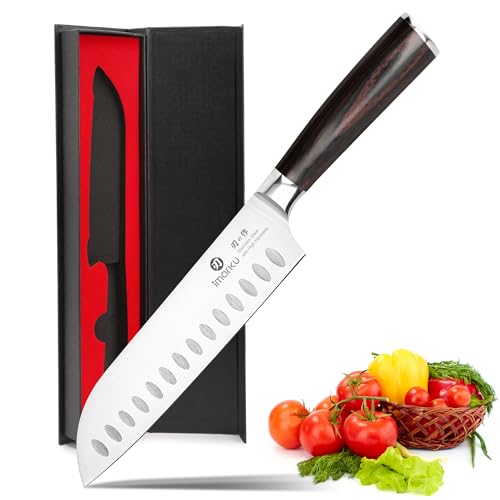
imarku Santoku Knife 7 Inch with Sharp Japanese High Carbon Stainless Steel
7 in$28.99 Check pricePrices change often
Common questions
What is the best santoku knife for a home cook
The Mercer Culinary Genesis 7 Inch at $39.95. It has a long track record in professional kitchens and culinary schools, a full tang for balance, and the flat blade profile a santoku is supposed to have, all at a price well below premium Japanese knife lines.
Should I buy a santoku instead of a chef knife
If you do most of your cutting with a straight, up-and-down chop on a flat board, a santoku may feel more natural. If you want one knife that handles the widest range of techniques, including rocking cuts, a chef knife remains the more versatile single choice for most kitchens.
What do the dimples on a santoku blade do
The scalloped dimples, sometimes called a granton edge, create small air pockets that reduce food sticking to the side of the blade during slicing. They offer a real but modest benefit for sticky foods like cucumber or cheese and do not significantly affect sharpness or edge retention.
Can a santoku knife go in the dishwasher
No kitchen knife belongs in a dishwasher, including a santoku. The heat, detergent, and movement inside the dishwasher dull the edge and can damage the handle or blade finish over time. Hand wash and dry it immediately after every use instead.
How is a santoku sharpened compared to a chef knife
The sharpening method depends on the steel, not the shape. A santoku in softer steel around 55 to 58 HRC responds well to a honing rod for routine touch-ups. A santoku in harder steel needs a whetstone. The flatter blade profile does not change which tool is appropriate.
Is a santoku a good first knife for a beginner
It can be, especially for someone with smaller hands or a smaller kitchen who mostly chops vegetables on a flat board. A budget option like the imarku Santoku at $28.39 is a low-cost way to try the shape before committing to a full knife collection built around it.