Best paring knives
Quick answer
The best paring knife for nearly everyone is the Victorinox Swiss Classic 3.25 Inch at $8.00: a paring knife does small, precise work close to the hand, and Victorinox's proven X55CrMo14 steel does that job as well as anything costing far more.

Victorinox Swiss Classic 3.25" Paring Knife, Straight Edge Spear Point
At $8.00, the Victorinox Swiss Classic 3.25 Inch is one of the best values in any kitchen drawer. A paring knife is used for peeling, trimming, and other small precision work held close to the hand, and its X55CrMo14 steel at about 55 to 56 HRC comes back sharp in seconds on a honing rod. There is very little a $30 paring knife does that this one does not.
The three tiers
Beginner: Best first paring knife
anyone who does not yet own a dedicated paring knife or has been making do with a small chef knife for detail work- Beginner pick
Victorinox Swiss Classic 3.25" Paring Knife, Straight Edge Spear Point
$8.00 Check pricePrices change often
The Victorinox Swiss Classic 3.25 Inch is a spear-point paring knife built on the same well-documented X55CrMo14 steel as the brand's popular chef knife, running about 55 to 56 HRC. That hardness is exactly right for a paring knife, which does light, repetitive, close-in work like peeling an apple or deveining shrimp rather than heavy chopping. It is soft enough to never chip on a stray pit or seed and quick to bring back to sharp on a rod.
Not for: someone who specifically wants a Japanese-steel paring knife for finer detail slicing and is willing to trade some durability for it
Intermediate: Best upgrade
someone who wants a slightly more refined feel and a full tang for better balance during detailed work- Intermediate pick
Mercer Culinary M20003 Genesis 3.5-Inch Paring Knife,Black
$21.19 Check pricePrices change often

The Mercer Culinary Genesis 3.5 Inch paring knife, at $21.19, is built on the same platform as Mercer's well-regarded santoku and chef knives, with a comfortable ergonomic handle and a full tang for better balance in the hand than a lighter stamped blade. For someone who does enough detail work, peeling, hulling strawberries, trimming fat, to notice handle comfort over long sessions, this is a genuine step up from the Victorinox without moving into premium Japanese pricing.
Not for: someone who is satisfied with a basic paring knife and does not do enough detail work to notice handle differences
Expert: Best for fine detail work
someone who wants a thinner, sharper-feeling edge for the most delicate paring tasks, like fine garnish work- Expert pick
imarku Paring Knife 3.5 Inch, Japanese High Carbon Stainless Steel
$29.99 Check pricePrices change often

The imarku Paring Knife at $29.99 is positioned as a Japanese-style high-carbon stainless option for detail work, which typically means a thinner grind that bites more easily into delicate tasks like citrus segmenting or fine garnish cuts. Because the specific steel composition is not confidently confirmed here, this recommendation is about the design category, a thinner Japanese-style edge, rather than an asserted hardness number, and it should be treated with the same extra care around hard contact that any thinner-ground knife deserves.
Not for: anyone who wants a knife they can be careless with, since a thinner edge is less forgiving of hard contact than the Victorinox or Mercer options here
| Knife | Price | Steel | Hardness |
|---|---|---|---|
| Victorinox Swiss Classic 3.25 Inch | $8.00 | X55CrMo14 | 55 to 56 HRC |
| Mercer Culinary Genesis 3.5 Inch | $21.19 | High-carbon stainless (full spec not asserted) | Not independently confirmed |
| imarku Paring Knife 3.5 Inch | $29.99 | Not independently confirmed | Thinner, Japanese-style grind |
Why does a paring knife not need premium steel the way a chef knife might
A paring knife's job is fundamentally different from a chef knife's. It handles small, precise, close-in tasks like peeling fruit, trimming fat, or deveining shrimp, done in short bursts rather than sustained chopping sessions. Because the cutting load is lighter and the contact is almost never against bone or a hard surface, the edge retention advantage of a harder steel matters much less here than on a knife doing an hour of vegetable prep.
This is why the Victorinox Swiss Classic at $8.00, built on the same solid but unremarkable X55CrMo14 steel at 55 to 56 HRC used in the brand's popular chef knife, is a completely appropriate choice rather than a compromise. Spending more on a paring knife buys handle comfort, fit and finish, or a thinner edge for delicate detail work, not a fundamentally better tool for the job most people ask a paring knife to do.
What is the difference between a spear-point and a bird's-beak paring knife
A spear-point paring knife has a straight, symmetrical blade that comes to a point in the center, and it is the most versatile shape for everyday tasks like peeling, trimming, and small slicing jobs. A bird's-beak, or tourne, paring knife curves downward toward the tip, which is specifically useful for turning vegetables into classic decorative shapes or for hulling strawberries with a scooping motion. Most home cooks are better served by a spear-point knife as their primary paring knife.
- Spear-point: straight blade, most versatile, best first paring knife
- Bird's-beak (tourne): curved blade, specialized for turning cuts and hulling
When does it make sense to spend $20 to $30 on a paring knife
It makes sense when handle comfort or a thinner, more precise edge genuinely matters to how you use the knife, such as someone who does a lot of fine garnish work, citrus segmenting, or delicate trim work where a thinner grind bites more cleanly. For general peeling and trimming duty, the gap between an $8 paring knife and a $30 one is smaller than the price difference suggests, and the extra money is often better spent on a whetstone or a second specialized knife.
Do I need more than one paring knife
Most kitchens are well served by a single good spear-point paring knife. A second one, often a bird's-beak style, is worth adding only if you regularly do decorative turning cuts or a lot of hulling and find yourself reaching for a paring knife for that specific job. Adding a second paring knife before adding a bread knife or a proper chef knife upgrade is usually the wrong prioritization for a growing knife collection.
If you are building a knife collection from scratch, prioritize a chef knife first, a paring knife second, and a bread knife third, since together these three cover the large majority of tasks in a typical kitchen. A second, specialized paring knife is a refinement worth adding later, not a priority for an early purchase.
How should I store and care for a paring knife
Hand wash and dry it immediately after use just like any other knife, and store it somewhere its edge is not knocking against other utensils in a drawer, ideally in a small sheath, a knife block slot, or on a magnetic strip. Because a paring knife is small and often kept loose in a utensil drawer, it is more prone to nicks from other tools than a chef knife stored properly, so a little extra care in storage goes a long way.
Is a stamped or forged paring knife better
For a knife this small, the difference matters far less than it does for a chef knife. A forged paring knife may offer a slightly heavier, more substantial feel and sometimes a small bolster, but the weight difference on a 3 to 4 inch blade is modest compared to the difference on an 8 inch chef knife. A stamped paring knife like the Victorinox Swiss Classic is lighter, which many cooks actually prefer for the kind of fine, close-in control paring work demands.
Because construction method has less practical impact here than on a larger knife, it is a reasonable factor to deprioritize when choosing a paring knife. Handle comfort, blade shape, and price are the more useful things to compare, and all three knives in this guide perform their core job well regardless of whether they are stamped or forged.
How we chose
This guide is researched from published manufacturer specifications and owner reports rather than in-person evaluation. A paring knife's job, small, close-in, precise cuts, means its steel does not need to be especially hard, so this guide weighs blade shape, handle comfort, and value at least as heavily as steel hardness, since even a modest steel spec performs this job well.
Every price and steel claim quoted here matches the exact listing referenced, and where a specific product's steel type is not confidently confirmed, this guide describes it in general category terms rather than asserting a number that cannot be verified for that listing.
Buying tips
Do I need to spend more than $10 on a paring knife
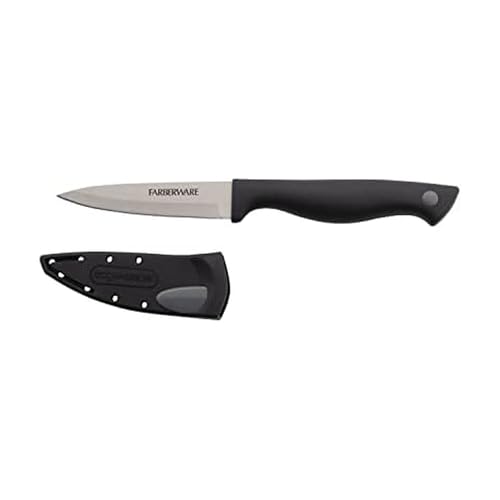
For most kitchens, no. A paring knife does light, close-in work: peeling, trimming, deveining, hulling. This is not a task that benefits much from premium steel, because the knife is not being pushed through dense food or used for long chopping sessions. The Victorinox Swiss Classic at $8.00 handles this job as well as knives costing three or four times as much, and the Cuisinart Triple Rivet at $8.95 or the Farberware Edgekeeper at $10.15 are similarly capable budget alternatives worth considering.
What blade shape should I look for in a paring knife
A spear-point blade, straight and symmetrical, is the most versatile shape for general paring tasks like peeling and trimming. Some paring knives use a curved, bird's-beak shape instead, which is more specialized for tasks like turning vegetables into decorative shapes. For a first or only paring knife, a straightforward spear-point is the more broadly useful choice.
Is a full tang important in a paring knife the way it is in a chef knife
Less so. Because a paring knife is small and lightweight to begin with, the balance benefits of a full tang are less noticeable than on a longer chef knife. A well-made stamped paring knife like the Victorinox Swiss Classic performs excellently without one. A full tang, as in the Mercer Culinary Genesis, is a nice refinement rather than a necessity, and it is not worth paying a large premium for on such a small blade.
How often does a paring knife need sharpening compared to a chef knife
Less often in most kitchens, simply because a paring knife typically sees lighter use and softer contact than a chef knife handling daily vegetable prep. A quick pass on a honing rod every few weeks, depending on use, is usually enough to keep a softer-steel paring knife like the Victorinox performing well. If a paring knife is used constantly for a specific repetitive task, such as prepping produce for canning, it will need attention on a schedule closer to a daily chef knife rather than the light, occasional use most kitchens put it through.
Other options worth knowing about
- Cuisinart
Cuisinart C77TR-3PR Triple Rivet Collection 3.5" Paring Knife, Black
$8.95 Check pricePrices change often - Mercer Culinary
Mercer Culinary M22003 Millennia Black Handle, 3.5-Inch, Paring Knife
$10.19 Check pricePrices change often


Common questions
What is the best paring knife for most people
The Victorinox Swiss Classic 3.25 Inch at $8.00. Its X55CrMo14 steel at about 55 to 56 HRC is exactly the right hardness for light, precise paring work, and at this price it is one of the easiest recommendations in any kitchen drawer.
Is it worth buying an expensive paring knife
Rarely. Because a paring knife handles light, close-in tasks rather than heavy chopping, premium steel offers less real-world benefit here than it does on a chef knife. Spend more only if handle comfort or a thinner edge for fine detail work specifically matters to how you cook.
What size paring knife should I buy
Somewhere between 3 and 4 inches covers nearly every paring task. The knives in this guide range from 3.25 to 3.5 inches, which is the standard, versatile range for peeling, trimming, and small precision cuts.
Can a paring knife go in the dishwasher
No. Like every knife, a paring knife should be hand washed and dried immediately. Dishwasher heat, detergent, and the jostling of a loaded rack dull the edge and create a safety hazard for anyone unloading it.
What is a bird's-beak paring knife used for
A bird's-beak, or tourne, paring knife has a curved blade suited to turning vegetables into decorative shapes and to hulling strawberries with a scooping motion. It is a specialized second paring knife rather than a replacement for a standard spear-point one.
How sharp should a paring knife be kept
As sharp as any other knife in the kitchen. A dull paring knife is arguably more dangerous than a dull chef knife because it is used close to the fingers for tasks like peeling, and a blunt edge that skates off food is more likely to slip toward the hand holding it.