Copper, lined vs Plain stainless steel
Quick answer
Copper, lined conducts heat faster, at about 401 W/m-K against 16. Copper, lined holds heat medium and Plain stainless steel holds it low. Choose copper, lined for sugar work, delicate sauces and anything where the pan must respond th and plain stainless steel for roasting pans, cooling racks, mixing bowls and steamer inserts.
Conductivity figures are published material properties. Oven ceilings are what manufacturers publish for each class of cookware.
| Copper, lined | Plain stainless steel | |
|---|---|---|
| Conductivity | 401 W/m-K | 16 W/m-K |
| Heat retention | medium | low |
| Responsiveness | the highest of any cookware material | medium |
| Evenness | the highest of any cookware material | poor on its own, which is precisely why cookware bonds it to aluminium |
| Induction | No | Depends |
| Oven ceiling | 450F | 500F |
| Reactive with acid | No | No |
| Needs seasoning | No | No |
| Weight | heavy | medium |
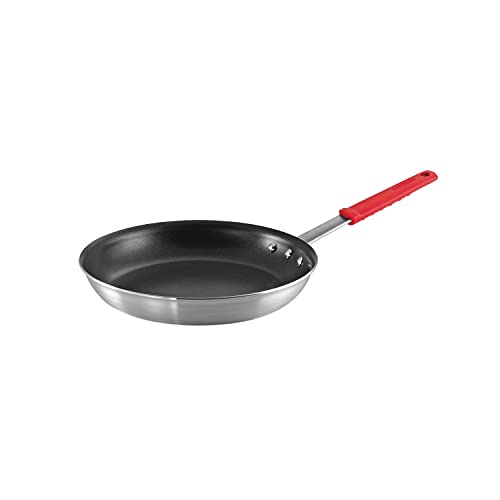
Which one heats faster?
Copper, lined, and by a wide margin: about 401 W/m-K against 16. Conductivity is how quickly heat moves through the metal, so a high figure means the pan reaches an even temperature sooner and responds faster when you change the burner.
Conductivity is not the same as heat retention, and confusing the two is the most common misunderstanding about cookware. Cast iron conducts poorly at about 52 W/m-K and retains heat extremely well, because retention comes from mass and specific heat rather than from conductivity. That is precisely why iron sears well: the pan barely drops in temperature when cold food lands on it.
Which one suits which job?
Copper, lined is best at sugar work, delicate sauces and anything where the pan must respond the instant the heat changes. Copper conducts about twenty five times better than stainless and roughly eight times better than cast iron. You are buying control, and paying for it in price, weight and upkeep.
Plain stainless steel is best at roasting pans, cooling racks, mixing bowls and steamer inserts. On its own stainless is a mediocre cooking metal. It is used for its inertness, strength and finish, not its heat behaviour.
Practical differences that decide it
Induction: Copper, lined is no and Plain stainless steel is depends. That alone settles the question for anyone with an induction hob.
Acid: Neither is reactive, so acidic cooking is fine in both. Oven ceiling: 450F against 500F, remembering that the handle usually decides the real limit rather than the material.
Weight and upkeep: Copper, lined is heavy and Plain stainless steel is medium. Neither requires seasoning.
The honest conclusion
Most kitchens should own both rather than choosing. They are good at different things, and neither is a substitute for the other. A mixed kitchen outperforms a matched one at every budget, which is the single most useful thing to understand about buying cookware.
If you genuinely have to pick one, pick on the job you do most often. Searing and browning point toward whichever of these holds more heat. Sauces and anything that needs quick control point toward whichever conducts faster.
Pans in both materials
- Lodge
Lodge Pre-Seasoned Cast Iron Skillet, PFAS-Free, 10.25 Inches
10.25 in$24.90 Check pricePrices change often - CAROTE
CAROTE 12 Inch Classic Granite Non Stick Black Frying Pan, PFOA-Free
12 in$27.99 Check pricePrices change often - Lodge
Lodge Pre-Seasoned Cast Iron Skillet with Silicone Handle Holder, 12 Inches
12 in$34.90 Check pricePrices change often - Lodge
Lodge Pre-Seasoned Cast Iron Skillet Set, 8, 10.25 and 12 Inches
12 in$64.90 Check pricePrices change often - All-Clad
All-Clad D3 Stainless Steel Fry Pan Set, 10&12-inch, Made in the USA
12 in$249.99 Check pricePrices change often


Common questions
Which is better, copper, lined or plain stainless steel?
Neither, in the abstract. Copper, lined is best at sugar work, delicate sauces and anything where the pan must respond the instant the heat changes. Plain stainless steel is best at roasting pans, cooling racks, mixing bowls and steamer inserts. Most kitchens benefit from owning both, because no single cookware material performs well at searing, at delicate release, at long acidic cooking and at rapid response.
Which heats up faster?
Copper, lined, at about 401 W/m-K against 16. Higher conductivity means heat spreads through the pan more quickly, so it comes to an even temperature sooner and reacts faster when the burner changes. It says nothing about how well the pan holds that heat once food goes in.
Which is better for searing?
The one that holds more heat, which here is Plain stainless steel. Searing is decided by how little the pan cools when cold food lands, which comes from mass and specific heat rather than conductivity. A thick, fully preheated pan produces a crust that a thin, highly conductive one cannot.
Which works on induction?
Plain stainless steel works on induction and Copper, lined is no. Induction couples only to ferromagnetic metal, so a fridge magnet on the base settles it definitively regardless of what the packaging says.
Which lasts longer?
Both will outlast the person who bought them if cared for. Neither has a coating to wear out, so the failure modes are warping from thermal shock and, on seasoned pans, letting rust take hold. Both are avoidable.